















Europe calls for US reset at security talks
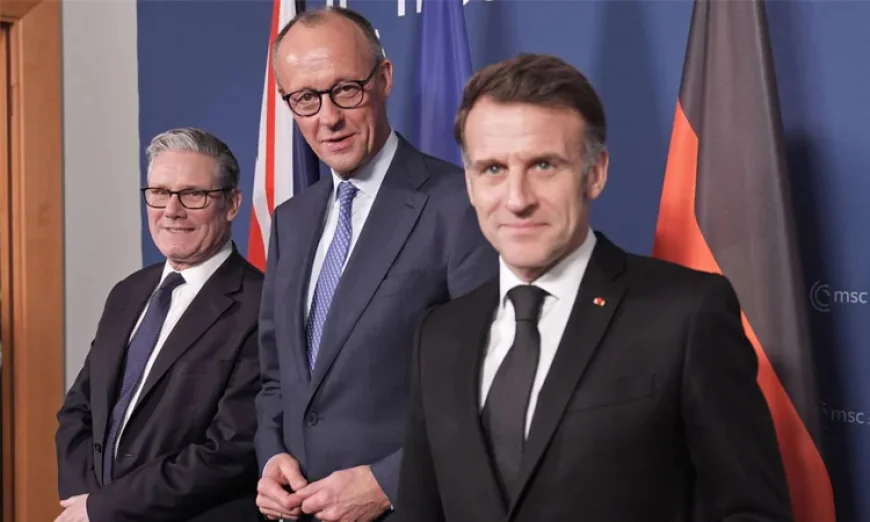
European leaders called Friday for a reset in relations with the United States as they met at a top security conference where US President Donald Trump's potshots at traditional transatlantic ties loomed large. German Chancellor Friedrich Merz urged "a new transatlantic partnership" and French President Emmanuel Macron called for "a strong Europe" as more than 60 leaders gathered for the annual Munich Security Conference. British Prime Minister Keir Starmer will meanwhile tell the conference Saturday that Europe is "a sleeping giant" and must rely less on the United States for its defence, his office said in a preview of his remarks.
This year's conference comes at a time of strained ties between Europe and the United States, after Trump threatened to take over Greenland and criticised "decaying" and "weak" European nations. Russia's war against Ukraine, set to enter its fifth year this month, is high on the agenda, alongside efforts by European NATO members to raise their defence budgets, in line with Trump's demands, out of concern that Moscow could seek to expand into their territory.
European leaders at the gathering defended their security commitments and the NATO alliance, which Trump's rhetoric has rattled. "Being a part of NATO is not only Europe's competitive advantage. It's also the United States' competitive advantage. So let's repair and revive transatlantic trust together," Merz said. "In the era of great-power rivalry, even the United States will not be powerful enough to go it alone." The gathering comes a year after US Vice President JD Vance used the conference's stage to attack European policies on immigration and free speech, shocking allies on the continent.
Macron emphatically defended Europe in his speech, saying "everyone should take their cue from us, instead of criticising us". Starmer's office said his speech would call for "a vision of European security and greater European autonomy that does not herald US withdrawal but answers the call for more burden sharing in full and remakes the ties that have served us so well". US Secretary of State Marco Rubio, who arrived on Friday, is also due to speak at the gathering on Saturday, as is Ukrainian President Volodymyr Zelensky, organisers said.
A German government source said Merz and Rubio had met at the conference and discussed "Ukraine, the status of negotiations with Russia and further support for the country, particularly in terms of military aid". They also discussed Iran and NATO, and "Rubio praised Germany's steps to strengthen the alliance," the source added. Rubio also met his Chinese counterpart Wang Yi on the sidelines of the conference, at a time of heightened Washington-Beijing tensions.
They agreed to strengthen cooperation, and Wang told Rubio that "dialogue is better than confrontation, cooperation is better than conflict, and win-win outcomes are better than zero-sum games", according to Chinese state news agency Xinhua. Rubio held a 15-minute meeting with the prime ministers of Denmark and Greenland about the future sovereignty of the Arctic island. Denmark's Mette Frederiksen called the talks "constructive". Ties plunged last month when Trump stepped up threats to annex Greenland, an autonomous territory of NATO ally Denmark, forcing European nations to stand firm in protest.
Merz, Macron and the leaders of the European Union, Canada and NATO met with Zelensky on Friday for talks on Ukraine. A US official said Rubio did not attend those talks due to a packed schedule, but was "engaging on Russia-Ukraine in many of his meetings" in Munich. Ukrainian Foreign Minister Andriy Sybiga said he discussed ending the Russian invasion with Wang, whose country is a close partner of Moscow.
Wang told Sybiga that Beijing was "willing to provide Ukraine with new humanitarian aid", according to a Chinese foreign ministry readout. Macron, meanwhile, said a new framework was needed to deal with "an aggressive Russia" once the fighting in Ukraine ends. "If it makes sense to talk, we are willing to talk," said Merz. "But as you can see with the American side, Russia is not yet willing to talk seriously."
Zelensky, urged by Trump to "get moving" on a deal to end the war, visited a drone factory near Munich with German Defence Minister Boris Pistorius before meeting with European leaders. "It's good to have strong partnership with Americans... but I think that Europe... needs (an) independent defence industry, very strong," he said. NATO's Secretary General Mark Rutte said on the sidelines of the conference that Europe was "stepping up... taking more of a leadership role within NATO" and "taking more care of its own defence". "A strong Europe in a strong NATO means that the transatlantic bond will be stronger than ever," Rutte said.