






























JETRO highlights Bangladesh as ‘high-stakes frontier' for Japanese investment
Bangladesh is rapidly emerging as a ‘high-stakes frontier for growth’ for Japanese companies, with a significant surge in profitability and a strong commitment to local market expansion.
In a presentation detailing the FY2025 Survey on Business Conditions of Japanese Companies Operating Overseas, Kazuiki Kataoka, Country Representative of JETRO Dhaka, revealed that 56.9% of Japanese firms in Bangladesh plan to expand their operations over the next one to two years.
“This expansion sentiment matches that of Vietnam and is primarily driven by the increase of local market demand, cited by 66.7% of surveyed companies,” he said while delivering the presentation at an event marking the Japan Business Day at a hotel in the city.
Organized by the Embassy of Japan and the Japan External Trade Organization (JETRO) Dhaka Office, the event was attended by chief guests, Dr Rashed Al Mahmud Titumir, Prime Minister's Adviser on the Ministry of Finance and Planning, and Chowdhury Ashik Mahmud Bin Harun, Executive Chairman of the Bangladesh Investment Development Authority (BIDA).
Kazuiki Kataoka said that the business outlook for Japanese enterprises in the country is on an upward trajectory.
Reffering the survey, he mentioned that 50% of Japanese companies in Bangladesh forecast an operating profit for 2025, a notable increase from the 41.9% reported in 2024.
The non-manufacturing sector is particularly bullish, with 62.2% of these firms expressing intentions to expand, significantly higher than the 47.6% seen in the manufacturing sector, he added.
He underscored Bangladesh’s massive market potential, supported by a population of over 180 million and a decade of sustained GDP growth exceeding 5-6%.
Kazuiki Kataoka said that Bangladesh is projected to become the 9th largest consumer market globally by 2030, surpassing the United Kingdom.
Per capita income is nearing the $3,000 mark ($2,769 in FY24-25), attracting Japanese brands to serve local consumers directly, he added.
Currently, he noted, approximately 350 Japanese companies operate in Bangladesh, with a growing presence in consumer-facing sectors.
High-potential areas include FMCG, food processing, electronics, automobiles, and healthcare, he mentioned.
He said that notable Japanese entities already making strides include Lion Corporation, Ajinomoto, Kewpie, Kikkoman, Mitsubishi (RANCON), and Honda, alongside the SHIP International Hospital.
He explained that the top advantages for investing in Bangladesh were identified as low labour costs, market scale, growth potential, and fewer linguistic barriers compared to other regions.
Furthermore, he said, Bangladesh leads developing countries in the region for Human Rights Due Diligence (HRDD) implementation, with 40.7% of companies already conducting these initiatives.
The morning session of the event was dedicated to the "Commemorative Event for EPA Agreement with Bangladesh."
The proceedings commenced with a welcome speech by Yutaro Mochida, Head of Economic Section at the Embassy of Japan in Bangladesh.
This was followed by an online message from Izuru Kobayashi, Deputy Director-General (Ambassador) at the Ministry of Foreign Affairs of Japan.
During this segment, Tareq Rafi Bhuiyan (Jun), President of the Japan Bangladesh Chamber of Commerce and Industry (JBCCI), and Shinichi Saida, Ambassador of Japan to Bangladesh, addressed the assembly.
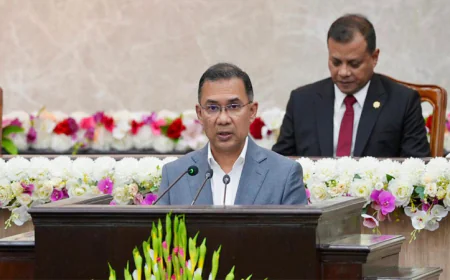
In his speech, Tareq Rafi Bhuiyan said that Bangladesh and Japan have embarked on a landmark transition in their bilateral relations, moving decisively from decades of development cooperation toward a comprehensive, rules-based economic alliance.
The proposed Bangladesh-Japan Economic Partnership Agreement (EPA), the nation’s first comprehensive bilateral agreement of its kind, represents a strategic evolution aimed at anchoring the country’s economic stability as it navigates the complexities of its upcoming transition from Least Developed Country (LDC) status, he added.
He said that the EPA is a defining moment in Bangladesh's macroeconomic policy.
As the nation approaches its graduation from LDC status, he said that it faces the inevitable expiration of existing preferential trade schemes, such as the Generalised Scheme of Preferences (GSP).
In this context, he mentioned that the EPA is an essential national imperative to replace diminishing protections with a structured framework for growth.
The afternoon session transitioned to a detailed examination of the "Investment Environment of Bangladesh based on 2025 JETRO Survey." Kazuiki Kataoka, delivered a presentation titled "2025 JETRO Survey on Business Conditions of Japanese Companies in Asia and Oceania."
Following the survey overview, a secondary presentation titled "Recent Japanese Interest in Bangladesh Consumer Market" was delivered by Tomotaka Minoura, Representative of JETRO Dhaka, and Shariful Alam, Senior Director of JETRO Dhaka.
A panel discussion, moderated by Tareq Rafi Bhuiyan (Jun), featured a diverse group of representatives from the public and private sectors.
The panelists included Nahian Rahman Rochi, Executive Member and Head of Business Development, BIDA; Manabu Sugawara, President, SHOO-KOO-KAI; Hiroshi Uegaki, Country Representative, Mitsubishi Corporation; Syed Nasim Manzur, Managing Director, Apex Footwear Limited; and Dr. M Masrur Reaz, Chairman and CEO, Policy Exchange Bangladesh.