






















PM calls on citizens to make tree planting a daily habit
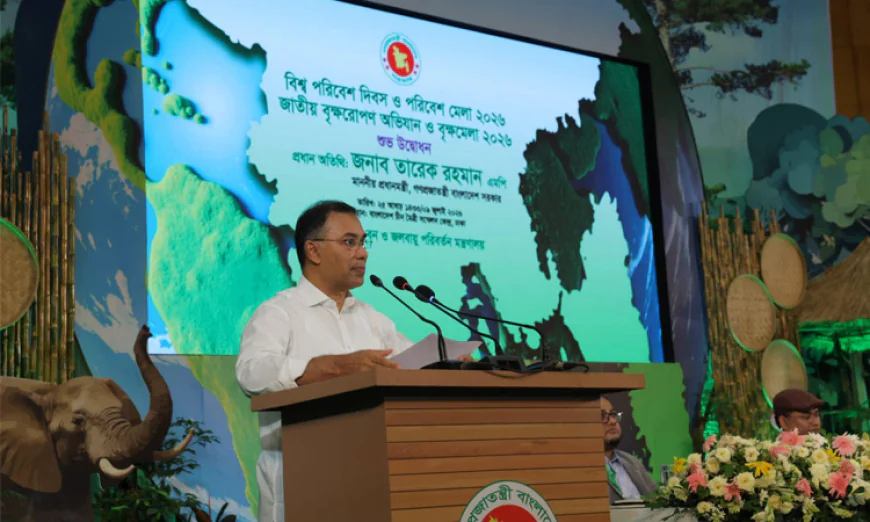
Prime Minister Tarique Rahman today urged the countrymen to transform tree planting and environmental conservation into a daily civic practice, saying the government is working to build a green, climate-resilient and sustainable Bangladesh.
“Tree plantation and environmental conservation should become a part of our everyday lives. If we can make these practices habitual, we will build a healthier and greener society,” he said.
The Prime Minister was addressing the inauguration ceremony of the World Environment Day programme, Environment Fair 2026 and the National Tree Plantation Campaign and Tree Fair 2026 at Bangladesh-China Friendship Conference Center here.
He urged the countrymen to lead the way in creating a truly green Bangladesh as the safety and well-being of humanity are closely tied to the protection and healthy development of the ecosystems.
“We all understand that greening our country is essential for the survival and well-being of future generations. Let us celebrate the birth of every child by planting a tree. May every newborn grow alongside a tree, allowing a nationwide social movement for afforestation to flourish,” he said.
Alongside this social movement, the government has undertaken several institutional initiatives to protect the environment which include introducing Green Volunteerism in educational institutions, launching the Climate Youth Fellowship, and establishing an Environment Start-up Fund, he mentioned.
Tarique Rahman said successful implementation of these initiatives will help build a safe, healthy, and environmentally sustainable Bangladesh for both present and future generations.
He said the government has launched a programme to plant 25 crore tree saplings over the next five years.
“Planting trees indiscriminately is not enough. Scientific assessment is necessary to determine which species are suitable for specific soils, climates, and ecosystems. Species such as eucalyptus and acacia grow rapidly, but further research is needed to determine whether they are truly beneficial for our environment,” he said.
He said priority should be given to indigenous species, including medicinal plants, orchids, bamboo, forest trees, fruit-bearing trees, commercially valuable species, and endangered native plants.
Afforestation alone is not the final goal as forests must also provide safe habitats and adequate food for birds, wildlife, insects, and other living creatures, he said.
He said environmentalists and forestry experts have an important role in ensuring that afforestation strengthens ecosystems. The government's objective is to maintain an ecological balance where plants, animals, soil, water, and air coexist in harmony, he said.
“Planting new trees is essential, but ensuring that those trees survive and thrive is even more important. Equally important is protecting mature trees that have long been part of our ecosystems rather than cutting them down,” he said.
The Prime Minister said the government has also taken a firm stand against deforestation, hill cutting, mangrove destruction, and wildlife poaching.
“For our own future, we must value our soil, rivers, forests, biodiversity, and natural resources. If we fail to protect our rivers, we cannot ensure agricultural productivity, food or water security,” he said.
He said environmental protection and economic development should not be viewed as competing goals instead development should progress in harmony with nature.
The government also aims to promote rooftop gardening, urban forestry, GIS-based tree plantation, riverside and canal-side greening, and eco-tourism as emerging sectors of the economy, he said.
“Climate change is no longer a future concern—it is our daily reality. Cyclones, floods, droughts, heatwaves, river erosion, and salinity intrusion are threatening agriculture, public health, the economy, and people's lives,” he said.
In response, Tarique Rahman said, the government views environmental protection not as a separate sector but as a cornerstone of national development.
“Our vision is to establish a green, clean, climate-resilient, and sustainable Bangladesh where economic growth and environmental conservation advance together,” he said.
In addition to tree planting, the government has begun implementing a programme to excavate and re-excavate 20,000 kilometres of rivers and canals across the country, he said.
This initiative will not only ensure year-round irrigation for farmers but will also strengthen Bangladesh's resilience to climate change, he said.
The Prime Minister said environmental improvement depends not only on tree planting or canal excavation. Comprehensive reform of waste management systems in cities, ports, municipalities, and suburban areas is equally essential, he added.
The government has already begun implementing measures to significantly reduce plastic waste, the premier said, adding, his government is also promoting compost production, recycling, waste-to-energy technologies, and the nationwide implementation of the principles of Reduce, Reuse, and Recycle—the 3Rs.
The Prime Minister said effective waste management cannot be ensured solely through municipal authorities or law enforcement. It requires responsible behaviour from every citizen.
He urged everyone to dispose of waste only in designated places to keep surroundings clean.
“We have discussed tree planting and environmental conservation as foundations of healthy human life. However, we must also recognize that population growth, climate change, unplanned urbanization, encroachment on rivers and wetlands, and deforestation have placed biodiversity under severe threat. These pressures are endangering the habitats of wildlife and aquatic plants and animals alike,” he said.
“Therefore, unless we protect ecosystems and ensure the safety of wildlife, domestic animals, birds, and all living creatures, no amount of human-centred development will make our society truly secure. Do not be cruel to wildlife. Do not mistreat dogs or cats. Protecting every form of life is essential for protecting humanity itself, and this responsibility belongs not only to the government but also to every citizen,” he said.
“May the country be a safe habitat for all animals and living beings,” Tarique Rahman said.
On the occasion of the World Environment Day, the Prime Minister congratulated everyone who has received the National Tree Plantation Award, the National Wildlife Conservation Award, and the benefits from the Social Forestry Programme this year.
With the theme: "Let's Beautify the Country through Tree Plantation, Bangladesh Comes First", the ceremony began with the recitation of the Holy Quran, followed by readings from other religious scriptures.
A documentary highlighting the current government's achievements in environmental protection, forestry, and climate change was then screened.
At the event, the Prime Minister presented the National Environment Award 2025, the National Wildlife Conservation Award 2026, and the National Tree Plantation Award 2025.
He also distributed dividend cheques to beneficiaries of the social forestry programme.
Environment, Forest and Climate Change Minister Abdul Awal Mintoo chaired the event while Prime Minister's Special Assistant on Environment, Forest and Climate Affairs Dr. Md. Saimum Parvez, and State Minister for Environment, Forest and Climate Change Shaikh Faridul Islam spoke as the special guests.
Following the ceremony, the Prime Minister planted saplings of olive, jarul, and neem trees on the premises of the Bangladesh-China Friendship Conference Center. He later visited various stalls at the Tree Fair held at the old Trade Fair Ground.
The fair has been organized to encourage greater public participation in environmental conservation, forest expansion, and efforts to address the impacts of climate change.
In addition to the month-long National Tree Fair and Environment Fair in the capital, 15-day tree fairs are being held in seven divisional cities, seven-day fairs in 56 district headquarters, and three-day fairs in 29 upazilas. A total of 120 stalls are participating in the National Tree Fair in Dhaka.
Earlier, on June 13, Tarique Rahman formally launched the nationwide programme to plant 25 crore trees in five years by planting a sapling of a Garjan tree in the Malumghat Reserved Forest in Chakaria, Cox's Bazar.