



































Beyond Business Friendly
A Balanced Framework for Evaluating National Budgets in an Agriculture Rooted Economy
The most business-friendly budget is not necessarily the one that offers the greatest concessions to business; it is the one that creates the strongest foundations upon which businesses of every size can compete, innovate, invest, and grow sustainably.
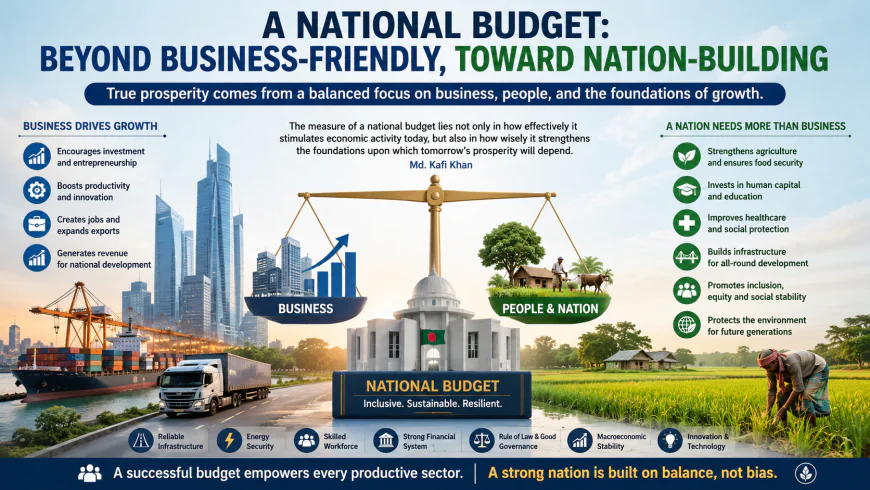

Every national budget marks far more than the beginning of another fiscal year. It represents one of the most comprehensive policy instruments available to any government, shaping investment decisions, influencing business confidence, supporting social development, allocating scarce public resources, and setting the strategic direction of an economy. Beyond its numerical estimates and fiscal projections, a budget communicates a nation’s priorities, its vision for development, and its understanding of the relationship between economic growth and public welfare.
Among the descriptions frequently associated with national budgets is the expression “business-friendly.” In many respects, such a characterization reflects an important objective. A vibrant private sector stimulates investment, creates employment, enhances productivity, expands exports, encourages innovation, and generates the tax revenues that finance essential public services. Countries seeking sustained economic transformation naturally strive to create environments in which entrepreneurship and enterprise can flourish.
Yet an equally important question deserves thoughtful consideration: Can the overall quality of a national budget be assessed solely by the extent to which it supports business, particularly in economies where agriculture, rural livelihoods, human capital, environmental sustainability, and social cohesion remain equally important pillars of development?
For countries whose economic foundations continue to rest upon a combination of agriculture, industry, services, and emerging knowledge sectors, the answer is necessarily more nuanced. A modern national budget should aspire not merely to be business-friendly in a narrow commercial sense, but to foster an economic environment in which businesses, farmers, workers, entrepreneurs, consumers, investors, researchers, and public institutions collectively contribute to sustainable national prosperity.
The objective, therefore, is not to diminish the importance of business. Rather, it is to broaden the analytical lens through which public finance is evaluated. A truly successful national budget strengthens the conditions under which every productive sector can contribute to long-term economic resilience.
“The measure of a national budget lies not only in how effectively it stimulates economic activity today, but also in how wisely it strengthens the foundations upon which tomorrow’s prosperity will depend.” Md. Kafi Khan
Business Is an Engine of GrowthBut Not the Entire Economy
Few propositions in economics command broader agreement than the importance of a dynamic private sector. Throughout modern history, businesses have served as powerful engines of economic transformation by mobilizing capital, introducing technological innovation, expanding productive capacity, generating employment, increasing exports, and improving national competitiveness. From small family enterprises to multinational corporations, private enterprise remains indispensable to sustainable economic growth.
Consequently, policies that encourage entrepreneurship, improve the investment climate, reduce unnecessary regulatory burdens, strengthen financial markets, and enhance investor confidence deserve serious consideration within any national budget. A supportive business environment encourages productive investment, accelerates industrial development, and contributes significantly to economic modernization.
However, businesses do not operate in isolation. Their success depends upon a much broader economic ecosystem. Productive enterprises require reliable infrastructure, efficient transportation, dependable energy supplies, skilled workers, sound financial institutions, functioning legal systems, effective public administration, stable macroeconomic conditions, technological innovation, and social stability. Each of these enabling conditions is itself supported through thoughtful public investment and sound governance.
The relationship between business and the wider economy is therefore reciprocal rather than one-directional. Businesses contribute to national development through investment and employment, while governments create the institutional and physical foundations that allow businesses to operate efficiently. Neither can achieve sustainable success independently of the other.
International experience consistently demonstrates that the world’s most competitive economies combine vibrant private sectors with strong public institutions, effective infrastructure, high-quality education, sound healthcare systems, transparent regulatory frameworks, and credible legal institutions. These complementary strengths reinforce one another, creating environments where innovation and long-term investment flourish.
“Businesses create wealth, but institutions create the environment in which wealth can be created sustainably. Lasting prosperity depends upon the strength of both.”Md. Kafi Khan.
Consequently, describing a budget as business-friendly should not imply that other sectors receive diminished attention. Rather, it should signify that the broader economic environment has become more conducive to productive investment while simultaneously strengthening the institutional foundations upon which all sectors depend. The ultimate objective is not to elevate business above the economy but to recognize business as one essential component of a larger system whose overall health determines national prosperity.
Agriculture Is More Than a Sector
For many developing and emerging economies, agriculture occupies a position that extends well beyond conventional economic classification. It is simultaneously a productive sector, a source of livelihood, a foundation of food security, a contributor to export earnings, a driver of rural development, and an essential component of national social stability. In countries where significant portions of the population continue to depend directly or indirectly upon agriculture, the sector performs economic, environmental, and social functions that are difficult to separate.
Agriculture contributes to national resilience in multiple ways. It sustains food production, supports rural employment, supplies raw materials to manufacturing industries, influences inflation through food prices, contributes to foreign exchange earnings in many economies, and increasingly plays a central role in climate adaptation and environmental stewardship. Public investment in agriculture therefore generates benefits that extend far beyond agricultural production itself.
Economic research has consistently demonstrated that improvements in agricultural productivity often produce substantial multiplier effects throughout the wider economy. Rising farm incomes increase rural purchasing power, stimulate demand for manufactured goods and services, strengthen local markets, encourage small enterprise development, and contribute to more balanced regional economic growth. Investments in irrigation, agricultural research, climate-resilient technologies, storage infrastructure, logistics, rural finance, extension services, and digital agriculture frequently enhance productivity across multiple sectors simultaneously.
In the context of fiscal policy, agriculture should therefore not be viewed merely as a recipient of public expenditure. Rather, it represents a strategic investment in long-term national resilience. Food security contributes to macroeconomic stability. Rural prosperity supports domestic demand. Climate-resilient agriculture strengthens environmental sustainability. Together, these outcomes reinforce broader economic development.
“Agriculture nourishes more than a nation’s food supply. It sustains livelihoods, strengthens resilience, stabilizes economies, and supports the foundations upon which broader prosperity is built.” Md. Kafi Khan.
Importantly, supporting agriculture should not be interpreted as competing with support for business. On the contrary, the two objectives frequently reinforce one another. Agribusiness, food processing, logistics, financial services, agricultural technology, manufacturing, and retail all benefit from a productive agricultural sector. Modern development increasingly depends upon creating stronger connections between agriculture, industry, services, and technology rather than treating them as competing priorities.
Accordingly, a balanced national budget recognizes agriculture not as a legacy sector requiring protection, but as a strategic sector capable of driving innovation, employment, environmental sustainability, and inclusive economic growth. In doing so, it contributes not only to rural development but also to the long-term resilience of the entire national economy.
Every Stakeholder Matters
A national economy is neither sustained by one sector nor defined by one constituency. It is a dynamic ecosystem in which governments, businesses, farmers, workers, entrepreneurs, investors, financial institutions, consumers, researchers, educational institutions, and civil society each perform distinct yet interconnected roles. The effectiveness of a national budget should therefore be evaluated not only by the extent to which it supports individual sectors, but also by how successfully it strengthens the relationships among them.
Economic policy often involves difficult choices because public resources are finite while development needs are extensive. Governments must determine how best to allocate limited fiscal resources among infrastructure, education, healthcare, agriculture, industry, social protection, technology, environmental resilience, and public administration. These decisions inevitably involve tradeoffs. Nevertheless, the ultimate objective of sound fiscal policy is not to maximize benefits for one stakeholder group at the expense of another, but to optimize long-term national welfare through balanced and evidence-based resource allocation.
An inclusive budget recognizes that prosperity is created collectively. Large industries contribute investment, technological advancement, exports, and employment. Small and medium-sized enterprises foster entrepreneurship, innovation, regional development, and economic diversification. Farmers safeguard food security and support rural economies. Workers provide the human capital upon which productivity depends. Consumers sustain market demand. Financial institutions mobilize savings and allocate capital. Universities and research institutions generate knowledge and innovation. Infrastructure providers connect markets and reduce the cost of doing business. Public institutions establish the legal and regulatory framework within which economic activity takes place.
The strength of any one stakeholder ultimately depends upon the strength of the wider system. Businesses cannot expand sustainably without skilled workers and reliable infrastructure. Agriculture benefits from efficient transportation, financial services, scientific research, and stable markets. Investors require sound governance and legal certainty. Governments depend upon a productive private sector to generate revenues, while citizens rely upon effective public institutions to deliver essential services. Sustainable development therefore emerges from cooperation rather than competition among stakeholders.
This interconnected perspective has become increasingly important in contemporary economic policy. International organizations such as the World Bank, the International Monetary Fund, the Organisation for Economic Co-operation and Development, and the United Nations consistently emphasize that resilient economies are those in which public policy promotes balanced development across multiple dimensions rather than concentrating exclusively on any single sector. Inclusive growth, institutional quality, environmental sustainability, innovation, and social cohesion increasingly complement traditional measures of economic performance.
“National prosperity is not the achievement of one stakeholder; it is the cumulative result of many institutions, sectors, and citizens advancing together under a shared framework of opportunity and responsibility.” Md. Kafi Khan.
Accordingly, the success of a national budget should be assessed by its capacity to strengthen the economic ecosystem as a whole. A budget that encourages productive investment while supporting agriculture, improving human capital, strengthening institutions, expanding infrastructure, fostering innovation, and protecting macroeconomic stability is more likely to generate durable and inclusive prosperity than one that prioritizes any single stakeholder in isolation.
The True Meaning of a Business-Friendly Budget
The expression businessfriendly budget has become a familiar feature of public policy discussions across the world. Yet the phrase is often interpreted too narrowly. It is sometimes associated primarily with tax reductions, fiscal incentives, or regulatory relaxation. While such measures may form part of a broader investment strategy, they do not by themselves define a genuinely business-friendly economic environment.
International experience suggests that businesses value predictability at least as much as preferential treatment. Investors make long-term decisions based not only on taxation but also on the quality of institutions, the consistency of public policy, the efficiency of public administration, the reliability of infrastructure, the availability of skilled labour, the stability of financial markets, and confidence in the rule of law. A budget that strengthens these structural foundations frequently contributes more to sustainable investment than short-term fiscal incentives alone.
Modern competitiveness is increasingly shaped by institutional quality. Efficient customs administration, transparent procurement systems, effective contract enforcement, digital public services, efficient logistics, reliable energy, robust telecommunications, and stable macroeconomic conditions reduce transaction costs for businesses across all sectors. Such improvements enhance productivity without necessarily favouring particular industries or firms. They also encourage entrepreneurship by lowering barriers to market entry and improving the overall ease of doing business.
Equally important is the recognition that businesses themselves are highly diverse. The needs of exportoriented manufacturers may differ from those of technology start-ups, agricultural enterprises, service providers, family-owned businesses, or small and medium-sized enterprises. A truly business-friendly budget therefore seeks to improve the overall business environment rather than concentrating benefits within a limited segment of the private sector. Policies that facilitate access to finance, encourage innovation, support digital transformation, strengthen vocational education, promote research and development, and expand market opportunities often generate economy-wide benefits.
Furthermore, the relationship between business and society should not be viewed as adversarial. Healthy businesses require healthy societies. Productive workers depend upon education and healthcare. Stable consumer demand depends upon rising incomes and employment. Reliable supply chains depend upon resilient infrastructure and environmental sustainability. Consequently, investments in human capital and public services frequently strengthen the long-term competitiveness of the private sector itself.
“The most business-friendly budget is not necessarily the one that offers the greatest concessions to business; it is the one that creates the strongest foundations upon which businesses of every size can compete, innovate, invest, and grow sustainably.” Md. Kafi Khan.
From this broader perspective, a business-friendly budget should not be viewed as an alternative to inclusive development. Rather, it should be understood as one component of a comprehensive development strategy in which business success, institutional strength, social progress, and economic resilience reinforce one another. Such an approach moves beyond short-term incentives toward the creation of a stable, competitive, and forward-looking economic environment capable of supporting sustainable national prosperity.
From Sectoral Thinking to Ecosystem Thinking
Economic policymaking has evolved considerably over recent decades. Earlier approaches often evaluated sectors independently, treating agriculture, industry, services, infrastructure, education, healthcare, finance, and environmental management as largely separate policy domains. Contemporary development economics, however, increasingly recognizes that these sectors are deeply interconnected. The performance of one frequently influences the productivity and resilience of many others.
An ecosystem approach to economic development acknowledges these interdependencies. Investments in transport infrastructure improve agricultural market access, reduce logistics costs for manufacturers, and strengthen tourism. Improvements in education enhance workforce productivity across every sector. Reliable energy supports industry, agriculture, digital services, and healthcare simultaneously. Advances in digital infrastructure expand financial inclusion, improve public administration, facilitate innovation, and strengthen commercial competitiveness. Environmental resilience protects agricultural production while reducing future fiscal risks associated with climate-related disasters.
This systems perspective has significant implications for national budgeting. Public expenditure should not be assessed solely according to the immediate beneficiaries of a particular programme but also according to its broader economic spillover effects. Investments that strengthen institutional quality, connectivity, research, human capital, and resilience often generate returns that extend far beyond the sectors in which the initial expenditure occurs.
The ecosystem perspective also encourages greater coordination across government institutions. Ministries responsible for finance, agriculture, commerce, education, energy, transport, technology, and environmental management increasingly share common development objectives. Effective budgeting therefore depends upon integrated planning rather than isolated sectoral decision-making. Such coordination improves policy coherence and enhances the long-term effectiveness of public investment.
“The strongest economies are not those in which sectors grow independently, but those in which sectors strengthen one another through intelligent policy, institutional coordination, and shared national purpose.” Md. Kafi Khan.
Adopting an ecosystem perspective also promotes resilience. Diverse and interconnected economies are generally better equipped to absorb external shocks because strength in one sector can partially offset temporary weakness in another. National budgets that encourage diversification, innovation, institutional quality, and productive linkages across sectors therefore contribute not only to economic growth but also to long-term stability.
Ultimately, moving from sectoral thinking to ecosystem thinking broadens the purpose of fiscal policy. A budget is no longer viewed merely as an allocation of public expenditure across competing interests; it becomes a strategic instrument for strengthening the productive relationships that enable an economy to grow in a balanced, sustainable, and inclusive manner.
Balancing Growth with Equity
One of the most enduring discussions in economic policy concerns the relationship between economic growth and social equity. For many years, these objectives were often portrayed as competing priorities, suggesting that governments must choose between accelerating economic expansion and promoting social inclusion. Contemporary economic research and international development experience, however, increasingly indicate that this is a false dichotomy. Over the long term, sustainable growth and inclusive development are not opposing goals; they are mutually reinforcing.
Economic growth generates employment, expands productive capacity, increases household incomes, and strengthens public revenue. These outcomes provide governments with greater fiscal space to invest in education, healthcare, infrastructure, scientific research, environmental protection, and social protection. Conversely, investments in human capital improve labour productivity, stimulate innovation, strengthen entrepreneurship, and enhance the competitiveness of the private sector. Growth therefore finances inclusion, while inclusion strengthens the foundations of future growth.
A welldesigned national budget recognizes this reciprocal relationship. Rather than treating productive investment and social investment as competing expenditures, it seeks to integrate them within a coherent long-term development strategy. Public resources allocated to education, vocational training, nutrition, healthcare, digital literacy, and research should not be viewed merely as social spending. They represent investments in the quality of human capital upon which future economic performance ultimately depends.
Similarly, targeted investments in rural infrastructure, agricultural modernization, climate resilience, and regional development can simultaneously promote equity and enhance national productivity. Such measures expand economic opportunities beyond major urban centres, reduce structural disparities, strengthen domestic markets, and create more balanced patterns of economic development. Inclusive growth is therefore not simply an ethical aspiration; it is also an economically rational strategy for improving national resilience and expanding long-term productive capacity.
Fiscal sustainability remains equally important. Budgets that seek to promote inclusion through unsustainable borrowing or persistent structural deficits may undermine future economic stability. Responsible public finance therefore requires balancing present needs with future obligations, ensuring that today’s development priorities do not impose disproportionate fiscal burdens upon future generations. This principle of intergenerational responsibility has become an increasingly important component of modern public finance.
“The strongest economies are built not by choosing between growth and equity, but by recognizing that enduring prosperity depends upon both advancing together.” Md. Kafi Khan.
Ultimately, balancing growth with equity requires more than the allocation of financial resources. It requires thoughtful policy design, effective institutions, fiscal discipline, and a long-term vision that understands economic development as a comprehensive process. Budgets that successfully integrate these dimensions contribute not only to higher rates of economic growth but also to stronger social cohesion, greater resilience, and broader public confidence in national development.
A Practical Framework for Evaluating Any National Budget
Public debate surrounding national budgets frequently focuses on individual measures such as taxation, subsidies, expenditure allocations, or fiscal deficits. While these components are undoubtedly important, evaluating a budget through isolated policy measures alone may overlook its broader strategic significance. International practice increasingly encourages assessing national budgets through a multidimensional framework that considers their overall contribution to sustainable development.
The first dimension concerns economic productivity. A strong budget should encourage investment, innovation, entrepreneurship, technological advancement, and improvements in productive capacity. Public expenditure and fiscal incentives should contribute to enhancing long-term competitiveness rather than merely stimulating short-term economic activity.
The second dimension is macroeconomic stability. Sustainable fiscal deficits, prudent public borrowing, effective revenue mobilization, manageable inflation, stable financial markets, and resilience against external economic shocks remain essential prerequisites for sustained economic confidence. Businesses, households, and investors alike benefit from predictable macroeconomic conditions.
A third dimension involves human capital development. Investments in education, healthcare, nutrition, scientific research, vocational training, and digital skills expand the productive potential of future generations. These expenditures should be viewed not simply as consumption but as strategic investments in national competitiveness.
The fourth dimension concerns agricultural and rural transformation. For economies where agriculture continues to play an important role, budgets should strengthen food security, climate resilience, irrigation systems, agricultural research, rural infrastructure, market access, and value-added agro-industries. Such investments generate economic returns that extend well beyond the agricultural sector itself.
Institutional quality represents another essential criterion. Transparent governance, efficient public administration, effective regulatory systems, independent institutions, digital government services, and sound public financial management enhance confidence among citizens and investors alike. Institutional strength frequently determines whether budgetary allocations ultimately translate into measurable development outcomes.
Environmental sustainability has likewise become an indispensable component of modern budgeting. Climate adaptation, disaster resilience, renewable energy, sustainable natural resource management, and environmental protection increasingly influence long-term economic stability. Ignoring these considerations may impose substantial economic costs upon future generations.
Finally, national budgets should be evaluated according to their capacity to strengthen social cohesion. Policies that expand opportunity, encourage productive employment, reduce structural inequalities, and support balanced regional development contribute to greater social stability and stronger long-term economic performance.
Taken together, these dimensions provide a more comprehensive framework for evaluating public finance than narrow discussions centred exclusively upon taxation or expenditure levels. They encourage policymakers and citizens alike to consider how fiscal decisions influence the broader trajectory of national development.
“A national budget should be judged not only by what it spends or saves, but by the strength, resilience, opportunity, and confidence it creates for future generations.” Md. Kafi Khan.
Such a framework also reminds us that successful budgeting is not measured solely by annual fiscal outcomes. Its true significance lies in its capacity to strengthen institutions, expand productive opportunities, encourage responsible investment, improve human well-being, and enhance national resilience over time.
The characterization of a national budget as “business-friendly” should be understood as one important element within a much broader framework of national development. Businesses remain indispensable drivers of investment, innovation, productivity, employment, exports, and economic transformation. Their success contributes significantly to national prosperity, fiscal sustainability, and international competitiveness.
At the same time, enduring economic progress depends upon far more than the success of any single sector. Agriculture safeguards food security and supports rural livelihoods. Education and healthcare strengthen human capital. Infrastructure connects markets and enhances productivity. Financial institutions mobilize savings and allocate capital efficiently. Public institutions establish the legal and regulatory certainty upon which private investment depends. Environmental stewardship protects the natural resources essential for future development. These elements are not separate priorities competing for attention; they are complementary components of a resilient economic system.
The most effective national budgets therefore recognize these interdependencies. Rather than favouring one stakeholder at the expense of another, they seek to create an enabling environment in which businesses, farmers, workers, entrepreneurs, investors, researchers, consumers, and public institutions can each contribute to sustainable national progress. Such an approach reflects not only sound economics but also prudent governance.
For agriculture-rooted and developing economies, this balanced perspective assumes particular importance. Long-term prosperity requires productive businesses, modern agriculture, skilled human capital, robust infrastructure, institutional integrity, diversified sources of finance, technological innovation, and responsible fiscal management. When these foundations are strengthened together, economic growth becomes more resilient, inclusive, and sustainable.
“The finest national budget is neither businesscentric nor sectorcentric. It is developmentcentricempowering every productive pillar of the economy to contribute to a stronger, more resilient, and more prosperous nation.” Md. Kafi Khan.
Ultimately, the true measure of a national budget lies not in whether it is described as business-friendly, agriculture-friendly, or industryfriendly. Its lasting success is determined by whether it expands opportunity, strengthens institutions, enhances productivity, preserves fiscal responsibility, promotes social cohesion, and builds confidence in the nation’s future. A budget that achieves these objectives becomes more than an annual financial plan; it becomes a strategic blueprint for sustainable and inclusive national development.
“A national budget is more than a financial document. It is a reflection of a nation’s economic philosophy, development priorities, and collective aspirations for future generations.” Md. Kafi Khan
The views expressed herein are intended solely for academic, professional, and public policy discussion. They should not be interpreted as commentary on any specific budget proposal or governmental decision. Economic priorities inevitably differ across countries depending upon their stage of development, fiscal capacity, demographic structure, institutional maturity, natural resources, and policy objectives. Accordingly, the principles discussed in this article are presented as general analytical considerations rather than prescriptive recommendations.






 Sponsored by