














BNP returns to power with major political mandate after 20 years
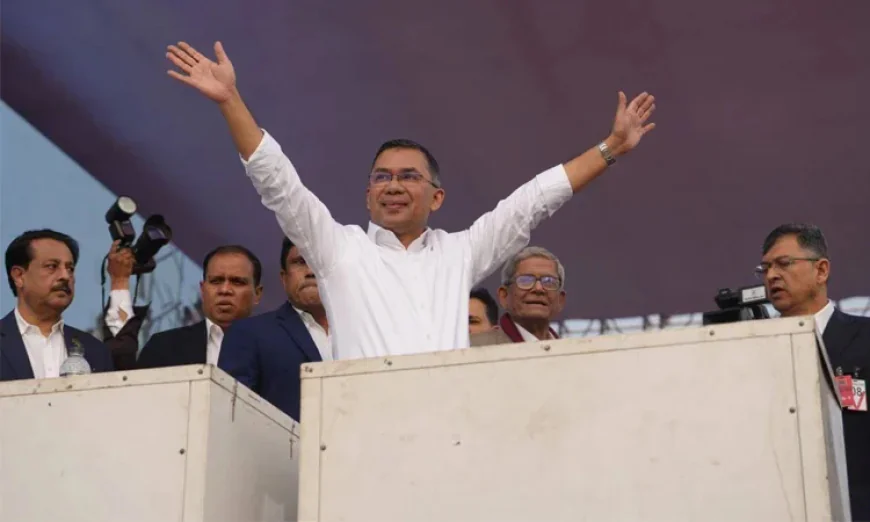
After a long struggle and years of waiting, BNP under the leadership of Tarique Rahman, is now preparing to form the government with a significant political mandate. The landslide victory in the February 12 Jatiya Sangsad Election has given the party the authority to amend the constitution and exercise full governing power on its own. According to official results of the election, BNP candidates won 209 out of 297 seats. In the 300-seat National Parliament, a party needs at least 151 seats to form a government—meaning 50.33 percent of the total seats. With victory in 69.66 percent of the seats, BNP is set to form the government with a massive majority.
Leaders and activists at all levels of the party are jubilant over this absolute victory. A sense of relief is sweeping through the party as it now awaits the formation and swearing-in of the new government and cabinet. The new government led by BNP is scheduled to take oath on Tuesday at the South Plaza of the Jatiya Sangsad Bhaban. Several factors contributed to BNP’s landslide victory. Among them are its commitment to the spirit of the 1971 Liberation War, the charismatic leadership of Tarique Rahman, the alleged persecution of millions of party leaders and activists during the more than 17-year rule of the fallen Awami League government, the party’s internal unity, and the immense sacrifices of its late Chairperson Begum Khaleda Zia and the Zia family.
However, the most significant factor behind the victory is considered to be the return of Tarique Rahman to the country. After 17 years in exile, his return and active leadership in electoral politics mark an exceptional event in Bangladesh’s political history. His leadership during the campaign, party unity, and organizational restructuring revitalized BNP. Political analysts believe that Tarique Rahman not only ensured electoral victory but also provided the party with a clear political roadmap focused on restoring democracy, administrative reforms, economic reconstruction, and establishing good governance.
His leadership has energized the party, engaged leaders across generations, and instilled hope for change among voters. Notably, increased acceptance and active participation were observed among youth and women. Tarique Rahman’s diverse campaign strategies, engagement with young voters and grassroots supporters, and timely election pledges—such as introducing a “Family Card” or “Farmers Card” and waiving agricultural loans—drew interest from people across all classes and professions.
Analysts say that his direct connection with grassroots leaders significantly strengthened the party’s organizational base. His handling of rebel candidates and merit-based nomination process helped resolve long-standing internal conflicts. His mature and flexible leadership has presented BNP as a modern and people-oriented party. His measured language and tolerant approach toward opponents have also helped reshape BNP’s previous image among general voters.
Economist and political analyst Prof Dr. Mahbub Ullah stated that the landslide victory was driven by Tarique Rahman’s strategic and intellect-based leadership. He carried out substantial groundwork from London, particularly in finalizing candidates while prioritizing grassroots expectations, said Mahbub Ullah adding his dynamic campaign and timely pledges attracted widespread public interest.
BNP Secretary General Mirza Fakhrul Islam Alamgir, who led the party through long years of struggle, said, “After a prolonged political struggle, bloodshed, and hardships, liberal democracy has triumphed in Bangladesh. This election proves that 180 million people of the country are united for change.” He added, “Today’s victory of BNP is the result of a long struggle. After the sacrifice and bloodshed of nearly 2,000 students, women, and children in July and August of 2024, we have now reached the main gate of democracy. This victory is a debt to the blood of those martyrs.”
Praising Tarique Rahman’s leadership, he said, “The past has proven that under his leadership, BNP is united, and so are the 180 million people of Bangladesh. He has shown the nation a new dream—of a transformed, free, and democratic Bangladesh. We wish to be illuminated by that new sunrise.” As the first election held after the mass uprising of 2024, BNP now faces significant pressure to fulfill its promises. The public expectation centers on restoring unity and stability. Post-election, there is a sense of relief among people, with hopes that political stability, economic discipline, and order will return.
Following the victory, Tarique Rahman stated at a press conference that the new government’s key goal would be restoring unity, peace, and stability instead of division, and he pledged to fulfill commitments made to the people. Analysts note that balancing regional and global geopolitics will be a major challenge for the BNP government. Under Awami League rule, Bangladesh had maintained very close ties with India. After the fall of that government, relations between India and Bangladesh’s interim administration have remained largely diplomatic.
Meanwhile, Pakistan is attempting to establish renewed relations with Bangladesh. China has made significant investments in Bangladesh’s infrastructure development. Maintaining balanced relations with both China and India was also a challenge for the previous government. Former diplomat Humayun Kabir said that although India is now keen to improve relations, the BNP government may face complexities regarding Pakistan. Simultaneously maintaining good relations with both China and India will also be challenging, he said adding globally, balancing ties between the United States and China will be another key test.
BNP Standing Committee member and newly elected MP Amir Khasru Mahmud Chowdhury said, “We will not lean toward any one country. Safeguarding national interest, sovereignty, and dignity, the new BNP government will maintain bilateral relations with the United States, China, India, Pakistan, and all other countries.” BNP last formed a government after winning the 2001 election. Although it secured a single majority, it led a four-party alliance government with Bangladesh Jamaat-e-Islami. In that election, the party’s “Sheaf of Paddy” symbol won 195 seats. In the latest election, Jamaat-e-Islami was BNP’s main competitor but suffered a significant defeat, winning 68 of the 297 declared seats, while its allies secured 9 more.
After leading a nine-year anti-Ershad movement, Khaleda Zia became the country’s first female Prime Minister following the 1991 election victory. BNP also briefly formed a government in 1996. BNP came to state power again in 2001 and thie tenure ended on October 28, 2006 when then Prime Minister Khaleda Zia submitted her resignation to the President. Following death of Khaleda Zia, BNP’s Standing Committee approved Tarique Rahman as the chairman. Under his leadership, BNP contested the 13th Jatiya Sangsad election and secured a sweeping victory in his first election as party chief.