



































Farming with surface water opens new horizon in Barind agriculture
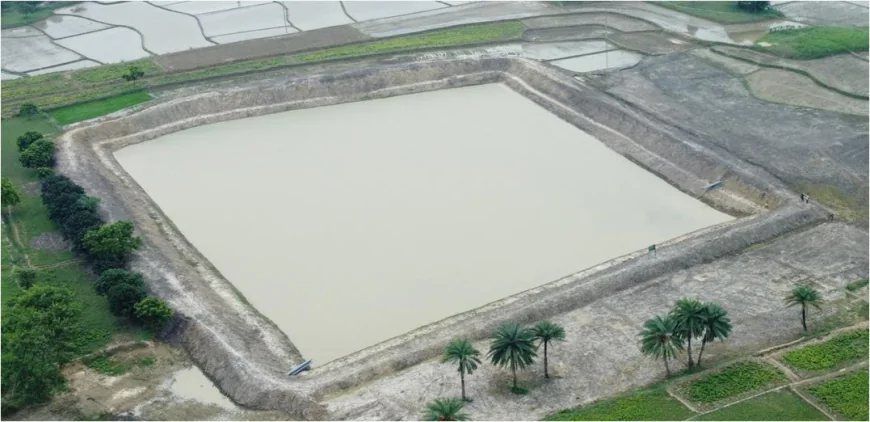
The once drought-stricken Barind region, long known for its arid and near-desert conditions, has emerged as one of the country's key agricultural hubs, driven largely by the effective use of rainwater and surface irrigation. A major role in this transformation has been played by the Barind Multipurpose Development Authority (BMDA), whose modern irrigation strategies, including canal excavation and surface water management, have significantly boosted both agriculture and the local economy.
Since its establishment in 1991-92, BMDA has been implementing a range of initiatives across Rajshahi, Chapainawabganj and Naogaon districts, bringing visible environmental and agricultural changes to the drought-prone region. To further expand surface water irrigation, BMDA has recently implemented a project titled "Small irrigation through pond re-excavation and surface water augmentation," aiming to reduce dependence on groundwater. Experts say surface water irrigation has become an effective tool to ease the mounting pressure on underground water resources in the Barind area, where numerous natural water bodies remain neglected.
As part of its efforts, BMDA has re-excavated 715 derelict ponds and 10 large water bodies, bringing them back into productive use. Local farmer Jubair Hossain, 65, from Sadar upazila, said modern irrigation technologies are revolutionizing agriculture in the region. "Excavating canals to bring river water and renovating ponds to enhance surface water use have made cultivation much easier," he said, adding that BMDA's activities, including seedling plantation, have transformed the overall landscape.
Another resident, Abdul Matin, echoed similar views, saying that coordinated efforts and effective planning are now improving farmers' livelihoods. According to data from BMDA's Chapainawabganj regional office, irrigation coverage has expanded significantly. Currently, 1,639 pumps are irrigating around 62,000 hectares of land, enabling farmers to grow three crops a year instead of one. This increased productivity is yielding approximately 6.50 lakh metric tonnes of crops annually, with an estimated value of Tk 1,625 crore.
Additionally, 100 low-lift pumps installed on the Mahananda and Punarbhaba rivers are irrigating about 4,000 hectares of land. A smart card-based prepaid metering system, introduced in 2003, is also helping prevent water misuse. Beyond irrigation, BMDA has contributed to environmental balance and rural infrastructure development. Around 1.5 crore fruit, timber and medicinal trees have been planted across the region. To conserve rainwater, some 230 kilometres of canals and 1,091 ponds have been re-excavated, reducing pressure on groundwater reserves.
The authority has also ensured safe drinking water for nearly 200,000 people through 234 water supply facilities. In addition, 186 kilometres of link roads and 1,400 kilometres of buried pipelines have been constructed, improving connectivity and facilitating agricultural marketing. Al Mamunur Rashid, executive engineer at BMDA's Chapainawabganj office, said two major project proposals worth Tk 1,426 crore have been submitted to the Ministry of Agriculture to extend irrigation facilities to another 18,000 hectares of drought-prone land using water from the Mahananda River.
Of the proposed projects, the Double Lifting Method Project is estimated at Tk 839 crore, while the Climate Change Impact Mitigation Project will cost Tk 587 crore. These initiatives include plans to re-excavate an additional 210 kilometres of canals and 150 ponds, plant 550,000 trees and install solar-powered irrigation systems. Professor Chowdhury Sarwar Jahan of the Department of Geology and Mining at University of Rajshahi highlighted the vast potential of surface water resources in the Barind region.
He said the region contains around 10,000 ponds, 200 canals and several large water bodies that could be revitalized through proper management. Citing research findings, he pointed to Beelbhatia, a large wetland of about 6,388 acres in Bholahat upazila of Chapainawabganj, which could irrigate tens of thousands of hectares year-round if properly re-excavated. Similarly, a four to five-kilometre-long water body in Rohanpur under Gomastapur upazila could bring around 10,000 hectares of land owned by 25,000 farmers under irrigation if restored. He also mentioned the long-neglected Chowdala-Boalia canal, saying that re-excavation of the two-kilometre canal could irrigate about 150 hectares of farmland.



 Sponsored by