
































Global Economic Signals and Their Implications for South Asia
Understanding Emerging Risks, Resilience, and Opportunities in an Interconnected World
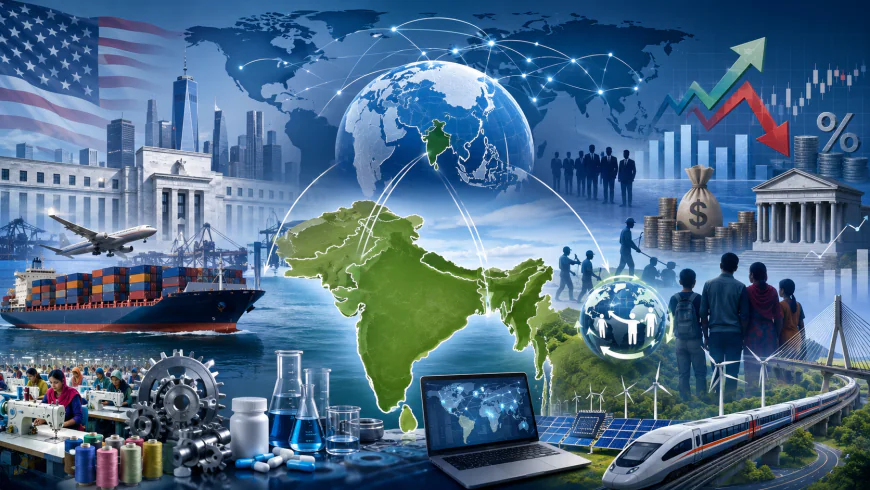

The global economy has entered a period in which developments in one major economy increasingly influence the prospects of many others. In today’s interconnected financial system, changes in consumer spending, interest rates, inflation, and investment patterns in the United States often extend beyond its borders, shaping economic conditions across Asia, Europe, Africa, and Latin America. For South Asia, understanding these global signals is essential for informed policymaking and longterm economic resilience.
Recent economic data published by the Federal Reserve, the International Monetary Fund, and the World Bank suggest that the United States continues to experience a period of relatively high borrowing costs compared with the years immediately following the COVID-19 pandemic. Household debt has increased in nominal terms, financing costs remain elevated, and consumer spending patterns continue to adjust in response to changing economic conditions. At the same time, the U.S. labor market has remained comparatively resilient, demonstrating that economic adjustments are often gradual rather than abrupt.
These developments should not be interpreted as evidence of an impending global recession. Instead, they illustrate how economic conditions evolve over time as policymakers seek to balance inflation control, employment, financial stability, and sustainable growth.
For South Asian economies, the principal concern lies in the indirect effects of these developments rather than in the financial position of American households themselves. The United States remains one of the world’s largest importers of goods and services. Consequently, changes in American consumption can influence export demand for many developing economies.
Bangladesh, India, Pakistan, and Sri Lanka each maintain significant trade relationships with the United States. Bangladesh’s readymade garment industry, India’s information technology services, pharmaceuticals and engineering products, Pakistan’s textile sector, and Sri Lanka’s apparel exports all benefit from sustained global demand. Should consumer spending in major advanced economies moderate over an extended period, exportoriented industries may experience slower growth in overseas orders. The magnitude of such effects would depend on broader economic conditions rather than on any single indicator.
International financial markets provide another important channel of influence. Periods of relatively higher U.S. interest rates can encourage global investors to allocate a larger share of their portfolios toward U.S. financial assets. Emerging markets may therefore experience greater competition for international capital, potentially increasing borrowing costs for governments and businesses. Economies with sound macroeconomic fundamentals, diversified financing sources, and credible policy frameworks are generally better positioned to manage these adjustments.
Exchange rate dynamics also deserve careful attention. A relatively strong U.S. dollar can increase the local currency cost of imported energy, industrial equipment, and other essential commodities for many South Asian countries. Such developments may contribute to inflationary pressures and influence monetary policy decisions. Maintaining adequate foreign exchange reserves and pursuing prudent fiscal management therefore remain important elements of economic resilience.
Remittances continue to serve as a significant source of foreign exchange for several South Asian economies. Millions of South Asians employed abroad contribute to household incomes and national economic stability through regular remittance flows. Although moderate economic adjustments in advanced economies do not necessarily lead to substantial reductions in remittances, sustained weakness in employment conditions could influence future growth in these inflows.
These global developments also present opportunities. Businesses continue to diversify international supply chains, seeking greater resilience, efficiency, and geographic balance. South Asian countries that improve infrastructure, strengthen institutions, invest in education and skills, simplify regulations, and maintain policy stability may attract increased investment over the medium and long term.
India’s diversified economic structure and expanding domestic market provide important buffers against external shocks. Bangladesh has established itself as one of the world’s leading apparel exporters and continues to explore opportunities in pharmaceuticals, information technology, agro-processing, leather products, and other highervalue industries. Pakistan, Sri Lanka, Nepal, Bhutan, and the Maldives likewise possess opportunities to strengthen competitiveness through reforms tailored to their respective economic circumstances.
History demonstrates that resilient economies are built through diversification, productivity growth, sound institutions, and prudent macroeconomic management rather than dependence upon any single market or source of financing. External developments cannot always be controlled, but preparedness and adaptability remain within the control of national policymakers and private sector leaders.
The current global environment therefore offers an important reminder. Economic resilience depends not on predicting every external development but on strengthening domestic institutions, encouraging innovation, maintaining financial stability, expanding productive capacity, and preserving investor confidence.
For South Asia, the most constructive response to evolving global economic conditions is continued investment in competitiveness, human capital, technological advancement, export diversification, and responsible economic governance. Countries that pursue these objectives consistently are likely to be better positioned to navigate future uncertainties while sustaining long-term and inclusive economic growth.
Global economic developments should therefore be viewed not only as potential sources of risk but also as opportunities to reinforce the foundations of sustainable development. In an increasingly interconnected world, resilience is ultimately built through preparation, adaptability, and sound economic institutions.





 Sponsored by