





































Trial by the Crowd, Truth on Trial
In the age of viral verdicts, accusation travels faster than facts.
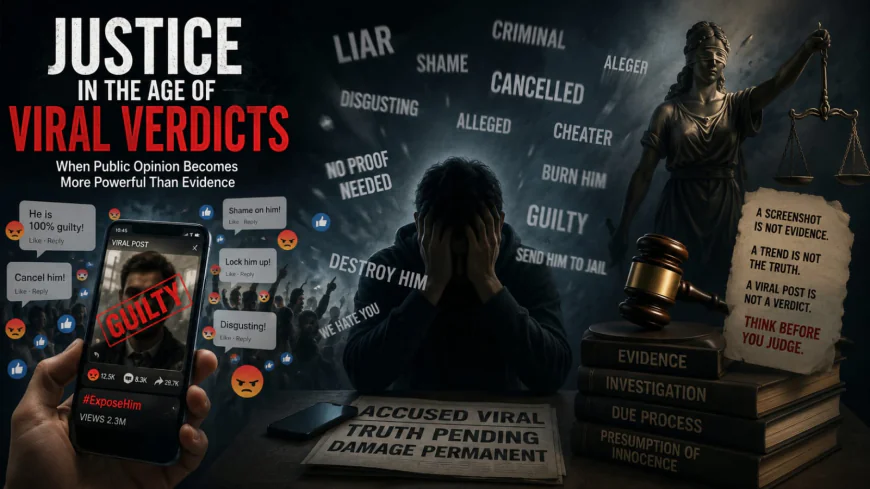

There was once a time when justice moved carefully. Allegations demanded proof, investigations required patience, and society understood the importance of hearing both sides before reaching conclusions. Today, however, the digital age has created a frightening new reality, one where public outrage often arrives before evidence, and where social media timelines have become modern-day courtrooms.
In this new culture, truth is no longer the first casualty of conflict; it is often the first thing ignored entirely.
A single screenshot, a short video clip, an edited conversation, or even an unverified accusation can spread across the internet within minutes. Thousands of people who know nothing about the individuals involved suddenly become emotionally invested judges. They comment, share, insult, threaten, and condemn, often without asking the most important question of all: “Is this actually true?”
The danger of this phenomenon is not merely technological. It is deeply psychological. Modern society has developed an unhealthy addiction to instant outrage. People no longer wait for facts because emotion has become more satisfying than accuracy. The internet rewards reactions, not restraint. Anger generates engagement. Public humiliation attracts attention. And attention, in today’s digital economy, has become a form of currency.
As a result, accusations now travel faster than investigations ever can.
This culture has given birth to what may be called “trial by the crowd”, a system where public perception becomes more powerful than legal process itself. Once someone becomes the target of online outrage, innocence often becomes irrelevant. The accused person is immediately expected to defend themselves before millions of strangers who have already emotionally decided the outcome.
Even silence becomes suspicious.
Even explanation becomes manipulation.
Even evidence sometimes becomes meaningless.
Perhaps the most alarming aspect of this crisis is how quickly society has normalized it. People now consume allegations the same way they consume entertainment content. Viral scandals are treated like public spectacles. Every controversy creates hashtags, reaction videos, opinion threads, and endless digital commentary from individuals who possess neither verified information nor personal involvement.
Some media outlets and content creators contribute heavily to this environment. In the race for clicks and engagement, sensationalism frequently replaces responsibility. Headlines are written to provoke outrage rather than encourage understanding. Partial information is presented as complete truth. Emotional narratives are amplified because they perform well in algorithms.
But algorithms have no morality.
They only reward attention.
The rise of artificial intelligence has made this situation even more dangerous. Today, fabricated screenshots, manipulated audio recordings, AI-generated images, and edited videos can appear disturbingly authentic. The average person is no longer fully equipped to distinguish between genuine evidence and digital fabrication. Yet despite this reality, society continues to react instantly and aggressively to whatever appears on a screen.
This creates a terrifying possibility: a future where reputations can be destroyed by content that never even existed in reality.
The consequences are devastating. Careers collapse. Families suffer humiliation. Mental health deteriorates. Personal relationships are destroyed. And even when the truth eventually emerges, the correction rarely spreads with the same intensity as the original accusation. Society remembers scandal more passionately than innocence.
None of this means wrongdoing should remain hidden. Genuine victims deserve to be heard, and real injustice must always be challenged. But justice cannot survive in an environment where emotion completely replaces evidence. A society that abandons due process for digital mob reactions slowly begins to undermine the very foundation of fairness itself.
Civilized justice was built upon patience for a reason. Facts require examination. Context requires understanding. Human lives require responsibility.
Unfortunately, social media culture encourages the exact opposite.
Today, many people fear not the legal system, but public exposure. They fear becoming the next viral target. Because once the crowd decides someone is guilty, the punishment often begins immediately, long before any courtroom, investigation, or verified evidence appears.
History has repeatedly shown that crowds are emotionally powerful but dangerously inconsistent. Digital crowds are no different. The only difference now is speed, reach, and permanence.
In the end, perhaps the greatest threat of the modern era is not misinformation alone, but society’s growing willingness to replace truth with emotional convenience. And if that trend continues, one day people may discover too late that the most dangerous courtroom in the world was never built from concrete or law books.
It was built from screens, algorithms, and the terrifying power of viral judgment.






 Sponsored by