
































Media Under Siege: Stories Drowned by Commerce


There is no longer any need for subtlety—the media is in decline, and it is happening in plain sight. What was once a platform for storytelling, truth, and cultural reflection has been overtaken by an aggressive and unapologetic obsession with profit. Commercialization is no longer a component of media; it has become its controlling force. In this transformation, content is no longer valued—it is sacrificed.
Turn on any television channel today and the pattern is unmistakable. A story begins to take shape, only to be abruptly and repeatedly interrupted by advertisements that seem to carry more importance than the program itself. The narrative is fractured, the emotional continuity destroyed, and the viewer reduced to a passive recipient of endless commercial messaging. This is not a technical flaw or a programming miscalculation—it is a deliberate strategy.
Advertising, in itself, is not the problem. Media has always relied on it for survival. The problem is the scale and dominance it has reached. Media organizations are no longer producing content to engage audiences; they are structuring content to accommodate advertisements. The shift is fundamental and deeply damaging. Content is no longer the product—it is the packaging.
Even global platforms such as Netflix and YouTube have increasingly embraced aggressive monetization models, introducing ad-supported tiers and algorithm-driven visibility systems. However, there remains a noticeable difference in execution. These platforms, despite their commercial motives, still attempt to preserve a basic level of user experience. In contrast, much of the local media landscape operates with little regard for balance, as though the audience has no limits, no expectations, and no right to uninterrupted engagement.
What we are witnessing is not simply commercialization—it is commodification in its most ruthless form. Audiences are no longer viewers; they are units of measurement. Their attention is segmented, priced, and sold. Their time is no longer respected; it is exploited. In this system, the quality of content is irrelevant as long as it succeeds in holding attention long enough to deliver advertisements.
The consequences are severe and far-reaching. Creativity is the first casualty. Writers are forced to distort narratives to fit unnatural breaks. Directors are compelled to compromise pacing and structure. The result is content that feels stretched, fragmented, and ultimately hollow. Storytelling loses its authenticity, replaced by a mechanical and predictable format designed around commercial interruptions.
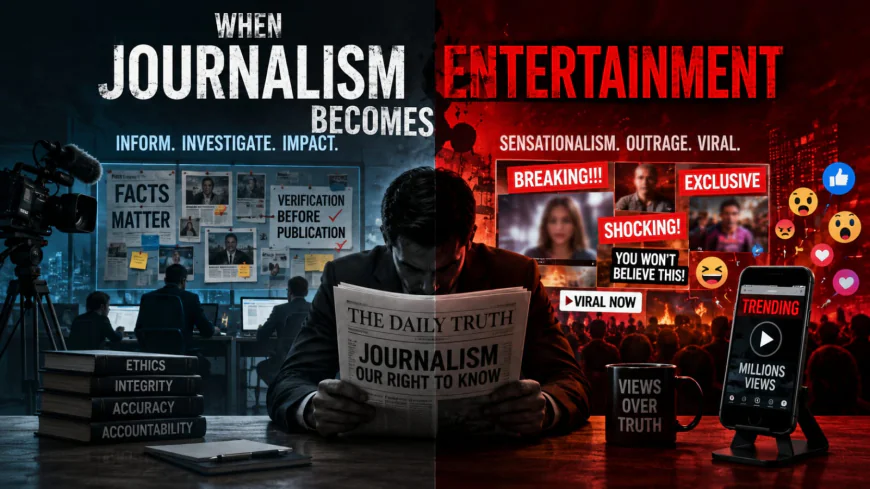
More concerning is the spillover effect into journalism. News, which should function as a pillar of public trust, is increasingly influenced by the same commercial pressures. Sensationalism is prioritized because it attracts attention. Depth and investigative rigor are neglected because they are less profitable. The line between editorial content and sponsored material becomes increasingly blurred, raising serious questions about integrity and independence.
There is also a deeper, more insidious impact on the audience. Constant interruptions condition viewers to accept distraction as normal. Attention spans are weakened, patience is eroded, and the ability to engage critically with content is diminished. Media, instead of fostering awareness and thought, begins to cultivate superficial consumption. This is not just a media issue—it is a societal one.
What makes this situation even more alarming is the normalization of it. Audiences express frustration, yet continue to consume. This passive acceptance is being interpreted as consent. Media organizations, emboldened by the absence of resistance, continue to push the boundaries further, testing just how much intrusion the audience is willing to tolerate.
This is a dangerous trajectory. Short-term financial gains are being prioritized over long-term credibility. Trust, once compromised, cannot be easily restored. Audiences may endure exploitation temporarily, but they will eventually seek alternatives—platforms that respect their time, intelligence, and experience.
The solution is not to eliminate advertising; that would be unrealistic. The solution is to impose limits. Commercial interests must not be allowed to dominate editorial decisions. Media organizations must recognize that their most valuable asset is not advertising revenue, but credibility. Without it, they become indistinguishable from any other commercial enterprise.
At its core, media is more than a business—it is a public institution. It shapes narratives, influences public opinion, and reflects the values of society. When it surrenders entirely to commercial pressures, it abandons that responsibility.
The question is no longer whether commercialization has gone too far—it clearly has. The real question is whether the industry has the discipline and integrity to correct its course. Because if this continues, the collapse of meaningful media will not come as a sudden event. It will happen gradually, through erosion—of trust, of quality, and ultimately, of relevance.
And when that point is reached, no volume of advertising will be enough to recover what has been lost.




 Sponsored by