
































Bangladesh PMI rises to 54.6 in April
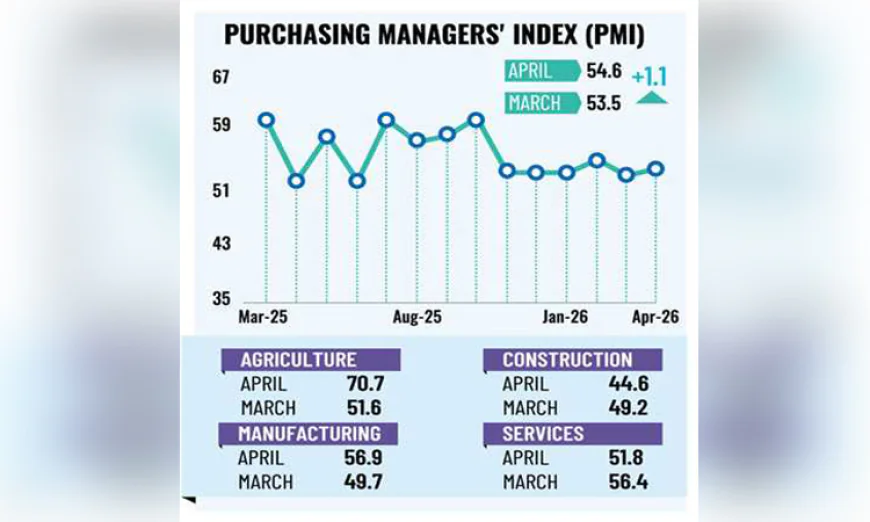
Bangladesh's overall economic activity expanded at a faster pace in April, with the Purchasing Managers' Index (PMI) rising to 54.6 from 53.5 in March, according to the latest Bangladesh PMI report released jointly by the Metropolitan Chamber of Commerce and Industry (MCCI) and Policy Exchange Bangladesh. The report, published on May 7 with support from the UK government and technical assistance from the Singapore Institute of Purchasing and Materials Management, indicated that the economy maintained an expansionary trajectory during April, driven mainly by stronger performances in agriculture and manufacturing, said a press release today.
The April PMI reading increased by 1.1 points from the previous month, signalling faster expansion in overall business activity. The manufacturing sector returned to growth after contracting in March, while agriculture sustained strong momentum. The services sector continued to expand, though at a slower pace, whereas the construction sector experienced a sharper contraction.
The agriculture sector recorded its eighth consecutive month of expansion, supported by faster growth in business activity, input costs and order backlogs. New business and employment also returned to positive territory during the month. Manufacturing rebounded into expansion on the back of stronger factory output, increased input purchases and higher input prices.
New orders, export orders and employment also returned to growth. However, finished goods inventories and imports remained in contraction, though at a slower pace than before, while supplier deliveries and order backlogs slipped back into contraction. Construction activity contracted for the third straight month, with the pace of decline accelerating further in April.
New business, construction activity and employment all remained weak, although input costs and order backlogs continued to expand at a slower rate. The services sector marked its nineteenth consecutive month of expansion, supported by growth in business activity, employment and input costs. However, both new business and order backlogs reverted to contraction during the month.
The report said future business expectations remained positive across agriculture, manufacturing, construction and services, indicating sustained optimism among businesses despite ongoing economic pressures. Despite several challenges, many businesses expressed cautious optimism that production and overall business conditions would improve in the coming months if the energy situation stabilises and broader economic conditions improve.
Commenting on the findings, the report noted that although the Middle East conflict has contributed to higher oil prices, supply chain disruptions and inflationary pressures, strong future business indicators across all sectors suggest that short-term business confidence in Bangladesh remains stable and cautiously optimistic.