
































80% Drop in Padma Flow Pushes 10 Rivers to Brink of Extinction
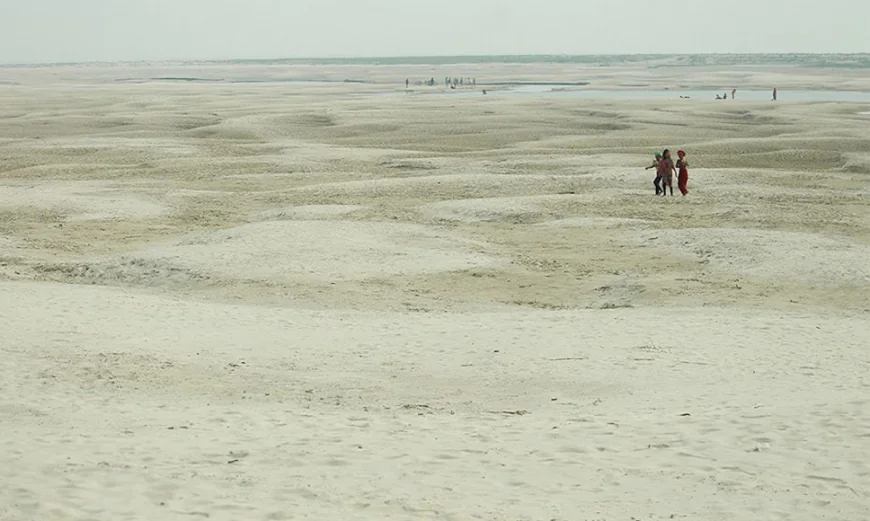
The Farakka Barrage has caused an 80 percent decline in the Padma's dry-season water flow, leaving nearly 10 rivers on the verge of extinction, according to a study by Riverine People, an organisation working on rivers.
The barrage, built on the course of a transboundary river in India’s West Bengal’s Malda and Murshidabad, has caused shoals to emerge in the Padma and dried up its distributaries, including the Pagla, Mahananda, Punarbhaba and Baral rivers, while the Kapotakkho, Bhairab, Mathabhanga and Kumar are on the verge of death.
In some stretches, the Kapotakkho River has only knee-deep water, while other sections have dried up completely. The little water that remains is from rainfall, as the river no longer receives any flow from the Ganges.
The Baral is one of the Padma’s distributaries affected by the water crisis. The river’s origin is at Charghat, downstream of Rajshahi. A vast shoal has emerged at the mouth of the Baral, where there is no water flow. Shoals have risen on both sides of the river, leaving only a narrow channel like a drain in the middle.
The Baral flows from the Padma through Rajshahi and Natore up to the Jamuna. Mohammad Rezaul Karim, a teacher from the Charghat area, who has witnessed the river’s life and death, said he had seen big boats ply the river.
River researchers said the Farakka Barrage has caused serious damage to the course of Bangladesh’s longest river and the flow of its distributaries.
Water experts said construction of the Farakka Barrage began in 1961 and was completed in 1975. The 2,240-metre-long barrage has brought extensive environmental and social changes in the south-western region of Bangladesh.
Considering its multidimensional impacts, including the death of many rivers and damage to livelihoods and biodiversity, there is strong opposition to the controversial barrage in Bangladesh and even in some parts of India.
For half a century, Bangladesh’s main allegation over Farakka has been that the barrage has caused vast shoals to emerge in the bed of the mighty Padma, narrowing its course.
By diverting water at the Farakka point during the dry season, India is creating a serious water crisis in the Padma. Overall, the country’s main river has fallen into an existential crisis.
On the other hand, India has consistently argued that there was no alternative to Farakka to save the Kolkata Port. A few years ago, the Bihar government also demanded demolition of the Farakka Barrage. The state alleged that it is submerged by floods every year because of Farakka. Erosion of the Ganges upstream and downstream of Farakka is also a major problem for people of that area.
A study by Md Imran Hossain, published in Springer Nature’s Discover Water journal (June 2026), said upstream water withdrawal is adversely affecting agricultural activities, soil fertility and fishery resources in nearly one-third of Bangladesh’s landmass.
Although the study cites an estimate of an annual loss of about US$ 600 million in the broader agriculture sector, it said not all of this is caused by Farakka alone, as internal water management and the effects of climate change are also involved.
Besides, a study by New Zealand-based researcher M M Q Mirza (1998) clearly showed an increase in salinity in the Gorai basin as a result of the withdrawal of Ganges water.
The study also noted that salinity, exacerbated by water diversion at Farakka, caused the largest decline in regional crop yields, reducing Boro production by 86 percent and Aman production by 71 percent.
According to data from the Bangladesh Rice Research Institute (BRRI) and the Bangladesh Bureau of Statistics (BBS), rice production in the country was about 12.5 million to 15.9 million tonnes in the 1971-72 fiscal year, which later rose to about 40.6 million tonnes in the 2023-24 fiscal year. This means overall rice production in the country has increased significantly. The increase was driven by modern seeds, fertiliser and irrigation systems.
But researchers said the real question is not that. It is how much higher production could have been without the abnormal decline in upstream water flow and the salinity.
Professor Nazrul Islam, former head of the Asian Institute for Growth Research and the UN Development Research, told BSS that India and Bangladesh have so far discussed common rivers from a commercial perspective, which gives no importance to the rivers’ natural role. The opposite of this is a nature-friendly approach, which emphasises that natural role.
Secondly, every river creates and sustains its own ecosystem in its valley, and both this role and its natural role are essential for the global ecological balance, he said.
Experience showed the commercial approach is short-sighted, because damage to a river’s natural role eventually damages its commercial and economic role too, he said, adding that the nature-based approach is far-sighted, because a river whose natural role is protected can keep performing its economic role as well.
Elderly people living along the Padma said that there used to be strong currents and the river was big. Now it is all shoals. When there was no barrage, the water had great force, power and current. Even four men would be nervous mooring a boat on one bank of this river, because the current was so strong. Now it is only dry land.
Fishermen in the Padma alleged that fish are no longer available as before due to the decline in river water. They no longer catch the species they used to get in the past. Many have therefore quit fishing as a profession.
Officials of the Kushtia Water Development Board told the media that the Gorai is one of the most important distributaries of the Padma. The river plays a key role in maintaining freshwater flow to the rivers of the south-western region and the Sundarbans.
They also said, “A total of 44 kilometres of shoals had formed in our Gorai river. At present, we are keeping the Gorai navigable through a dredging and bank protection project.”
They added, “And we have 11 rivers in Kushtia. These rivers are linked with the Padma and the Gorai. If water is not available in the Padma at all, these rivers will become almost dead.”
Besides rivers, a major concern for the Water Development Board is the Ganges-Kobadak irrigation project.
The country’s largest irrigation project is entirely dependent on Padma water. The irrigation system was developed in the 1960s to irrigate about 100,000 hectares of land in four districts. Due to water shortages at different times caused by the Farakka Barrage, the irrigation project has had to be kept shut.





 Sponsored by