






































Europe’s Strain, Asia’s Bank Balance Sheets
How a distant slowdown can become a local credit and liquidity challenge
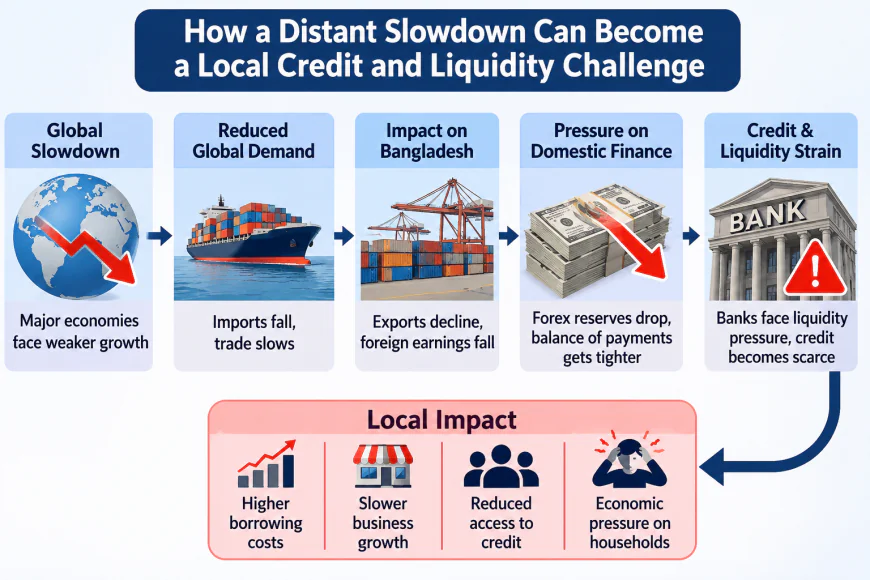

A European retailer that delays an order may eventually affect a factory in Asia. A factory that receives less revenue may postpone payments to suppliers or struggle to service its bank loans. At the same time, higher fuel prices can increase the borrower’s operating costs and the country’s import bill. A distant shock can therefore reach an Asian bank through several doors at once.
This does not mean that Europe’s difficulties will automatically cause a banking crisis in Asia. The effects will vary by country, bank, borrower and currency. Many Asian economies have continued to show resilience, and the International Monetary Fund says the region has adapted to energy disruption and trade reconfiguration, although its buffers are not unlimited. The banking question is how prepared financial institutions are for several pressures arriving together.
The first channel is the borrower
Banks do not usually have to lend directly to a European company to feel the effects of weaker European demand. Their exposure may be through local exporters, suppliers, logistics firms and small businesses that depend on those exporters.
If European consumers and businesses spend less, Asian firms may face fewer orders, tighter prices or longer payment cycles. That can weaken cash flow before it appears as a missed instalment. Exporters may draw more heavily on working capital, delay payments to suppliers or seek an extension of loan terms. Smaller firms in the supply chain may have less bargaining power and fewer reserves than their larger buyers.
For Bangladesh, the link is material. The European Commission identifies the EU as the country’s largest trading partner, accounting for 21.5 per cent of Bangladesh’s goods trade in 2025. A sustained fall in European orders could therefore affect borrowers in export manufacturing and the businesses that serve them. The outcome would depend on the scale and duration of any fall, the borrower’s financial strength and its ability to find other markets.
Banks should look beyond the headline exposure to direct exporters. A loan portfolio may include transport providers, packaging firms, warehouses, freight forwarders and suppliers whose income depends on export production. These indirect links can make the true concentration risk larger than the sector labels in a credit report suggest.
Energy costs can turn pressure into credit risk
A second channel runs through energy and commodity prices. The 2026 disruption around the Strait of Hormuz has affected global energy flows. The Asian Development Bank has linked the prolonged energy and supply chain disruption to higher production costs and weaker activity across parts of developing Asia. Its July outlook lowered the region’s 2026 growth forecast, while identifying higher oil and gas prices as a source of broader inflation pressure.
For an importing economy, an energy shock can raise the cost of fuel, transport, electricity and materials. A business may face higher expenses while customers resist higher prices. Households may have less income available for loan repayments after paying more for essentials. Governments may also face additional fiscal pressure if they subsidise fuel or electricity.
Banks can experience the effect through slower repayments, requests for new working capital, weaker collateral values or increased restructuring needs. The pressure may be most serious for borrowers that have thin margins, high debt, limited pricing power or substantial foreign currency obligations.
This is where credit assessment needs to move beyond asking whether a borrower is profitable today. A bank should also understand how long the borrower can withstand higher input costs, how quickly it can adjust prices, whether it has alternative suppliers and what happens if its main buyer reduces orders.
Currency and funding pressures
Higher import costs can also place pressure on a country’s foreign exchange market. If the currency weakens, borrowers with foreign currency liabilities may need more local currency to meet the same payment. Exporters with foreign currency income may be naturally hedged, but only if the timing and amount of receipts match their obligations. Other borrowers may carry a mismatch that is difficult to see during calm conditions.
Banks themselves can face foreign currency liquidity and rollover risks. The Bank for International Settlements notes that foreign currency funding shortages can become a source of financial stress when funding markets are impaired. Hedging can reduce currency mismatches, but it may create rollover risks if the hedge cannot be renewed on acceptable terms.
This does not mean that every bank with cross border business is vulnerable. It means foreign currency liquidity should be assessed under stress, including the reliability of correspondent relationships, access to trade finance and the ability to meet legitimate client needs if markets become less liquid. Banks should also distinguish between short term funding pressure and a deeper solvency problem. The policy response to one may not be suitable for the other.
Market prices, interest rates and sovereign risk
A further transmission channel runs through financial markets. If investors become more cautious, bond yields, exchange rates and funding costs may change. Higher rates can increase income for some banks, but they can also weaken borrowers, raise deposit costs and reduce the value of securities held on balance sheets.
The European Banking Authority’s 2026 risk assessment described EU and EEA banks as resilient overall, while noting that sovereign exposures and interest rate risks vary significantly across banks. That assessment is about European banks, but it illustrates a broader supervisory point. Strong aggregate capital figures can conceal weaker positions in particular institutions or countries.
Asian banks need to consider their own links between sovereign risk and bank balance sheets. Where banks hold substantial government securities, changes in yields can affect market values and liquidity. Where public finances are strained by energy subsidies or reduced revenues, confidence in sovereign borrowers may also matter to banks. These are connected risks, but they do not move identically in every country.
What the stress tests do and do not say
The IMF’s October 2026 Global Financial Stability Report includes a severe stress scenario involving energy disruption, higher interest rates and a sharp repricing of financial assets. In that scenario, banks representing 22 per cent of global banking assets fall below a specified capital threshold. The report notes that, in Asia, the share of weaker institutions in the scenario reflects substantial capital depletion in oil and gas importing economies. This is a stress test, not a forecast that those losses will occur. Its value is to show how interacting shocks could expose vulnerabilities that are less visible in normal conditions.
The distinction between a scenario and a prediction is essential. A stress test helps boards and supervisors ask what could happen if conditions deteriorate sharply. It does not establish that a banking system is already in crisis. The more useful response is to identify which institutions, sectors and borrowers would be most exposed, and whether current buffers are adequate for those specific risks.
Bangladesh demonstrates why country context matters. The World Bank reported that the country’s banking sector remained vulnerable, with a nonperforming loan ratio of 30.6 per cent in December 2025 and aggregate capital below the regulatory minimum. Those are significant domestic weaknesses. They should not be attributed to Europe’s economic challenges. But they may reduce the system’s ability to absorb a new external shock, particularly if higher energy costs, weaker exports or foreign exchange pressures add to existing problems.
The boardroom response
For bank boards, the practical task is to connect external developments with the bank’s own risk profile. A single dashboard showing total exposure to Europe may not be enough. Directors and senior management need to understand concentrations by borrower, industry, buyer, currency, tenor and supply chain. They need to know which clients depend on European demand, which are exposed to energy imports and which carry material foreign currency mismatches.
Scenario analysis should consider combined pressures. What happens if orders fall while input costs rise? What if exchange rates weaken at the same time that trade finance becomes more expensive? Which large borrowers have enough liquidity to withstand delayed receipts? How quickly can the bank identify stress in smaller firms that depend on a few major exporters?
The answers should inform credit limits, early warning indicators, collateral assessment, liquidity planning and contingency funding arrangements. They should also shape constructive engagement with clients. A temporary cash flow gap in a viable business may require a different response from a business whose model has become unsustainable. Timely restructuring can preserve value, but it should not be used to conceal poor underwriting or delay recognition of losses.
Banks should also protect the quality of their risk data. Group level exposure can look acceptable while risk is concentrated in a particular supplier, export market or currency. Board reporting should make those connections visible without turning every possible risk into an alarm. Clear escalation criteria help management act early and consistently.
From exposure to resilience
Europe’s difficulties may create opportunities as well as risks. European firms seeking diversified suppliers, new investment locations and reliable access to materials may consider partners in Asia. Banks can support viable trade, infrastructure and supply chain investment. But opportunity should not become an excuse for weak due diligence. New business still requires sound credit assessment, transparent ownership, credible cash flows and appropriate environmental and social review.
The most resilient banks will not be those that predict every European political or economic development. No board can do that. They will be those that understand how external shocks reach their borrowers, maintain realistic buffers and act before temporary pressure becomes permanent impairment.
Europe’s economic strain is not, by itself, an Asian banking crisis. It is a reminder that modern banking risk travels through commercial relationships as much as through financial markets. A thoughtful bank will not treat global uncertainty as a reason to retreat from lending. It will use better information, stronger governance and disciplined judgment to continue financing sound businesses while recognising where the ground beneath them may be shifting.





 Sponsored by