






































Rajshahi's Bilnepalpara declared a pollinator-friendly area for bees
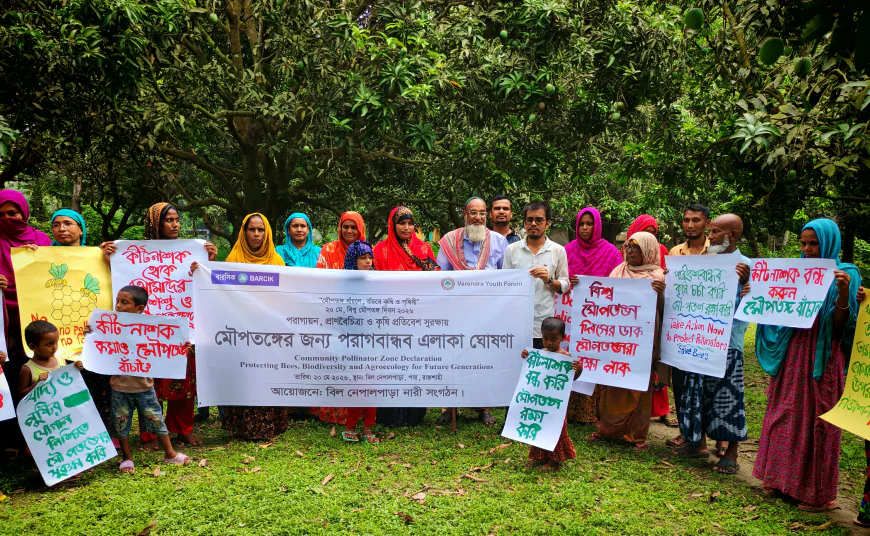
Bilnepalpara village under Paba upazila in the district has been declared a pollinator-friendly area for bees to protect pollination, biodiversity, and agro-ecology. The declaration was made today during a programme organised by the Bilnepalpara Women's Organization on the occasion of "World Bee Day". Bees and other pollinating insects increase our agricultural production, ensure plant reproduction, conserve biodiversity, keep our food system stable, and maintain environmental balance. But day by day, bee species are declining dangerously due to agricultural chemicalization and the loss of natural environments. So, ensuring their protection is our responsibility.
With this goal, the area has been declared a pollinator-friendly zone for bees. Farmers, both men and women, and local residents jointly made this declaration. They stated that no chemical fertilizers or pesticides will be used in this area. They further called for every region of Bangladesh to be declared a pollinator-friendly area for bees. They said government initiatives must be taken to stop pesticide use nationwide and to expand agro-ecological and local agricultural practices. The programme was organised by the development research institution Bangladesh Resource Centre for Indigenous Knowledge (BARCIK), Barendra Youth Forum, and the Bilnepalpara Women's Organization. Farmers, elderly residents, youth, students, and people from various professions in Bilnepalpara were present.
The event was conducted by BARCIK Associate Programme Officer Touhidul Islam. The importance and necessity of bees were presented by Atikur Rahman Atik, president of Barendra Youth Forum. He said more than 20,000 species of bees have been documented worldwide. Scientists also estimate that there are around a hundred thousand species of bees on Earth, including both seen and unseen. Many pesticides used in agriculture are extremely harmful to pollinating insects. Especially when pesticides are sprayed indiscriminately during flowering and in daytime, bees are directly poisoned. This crisis should not be seen only as a question of agricultural production, but as a broader environmental, multi-species, and political-ecological crisis.
Farmer Golapjan Begum, 62, said, "Earlier, we saw a lot of wasps, honey bees, daras, bumblebees, and various small and large flies and insects. They used to build nests in our homes, at doors, and inside houses. Now we don't see them anymore. Now we have to use poison for pests on pointed gourd and rice. Earlier there was no poison, yet crops grew without poison and chemical fertilizers." Farmer Abdus Salam, 60, said, "Bees can no longer survive in the area. Due to excessive pesticide use, insect populations have declined greatly. Without these insects, pollination is not happening, so crop yields are lower. People are being harmed."
He added, "Government initiatives must be taken to produce organic pest control and transition to natural farming. Farmers must be encouraged. Incentives and support must be provided for farmers." Farmer Sultana Khatun said, "We have been practicing agroecology for a long time. Here we have an agroecology learning center and a community seed bank. Here, farmers are encouraged and taught to make and use organic pest control." She also said, "The poisons of various multinational companies have destroyed our bees and beneficial plants and insects, causing a silent pollination crisis and harming us."



 Sponsored by