



































Stronger internal audits to safeguard public funds and improve service delivery
Bangladesh moved towards a stronger internal audit system in the public sector to detect risks before they caused financial losses or disrupted essential public services.
The system also proposed permanent staffing and independent oversight aimed at replacing a system that depended on temporarily assigned staff and lacked the capacity to carry out audits effectively.
The reforms were discussed at the "Workshop on Institutionalizing Internal Audit in the Public Sector: Sustainability and Way Forward", held on October 8-10 at a hotel in Gazipur, organised by the Internal Audit and Audit Follow-up Scheme under the Strengthening Public Financial Management Program to Enable Service Delivery (SPFMS) of Finance Division.
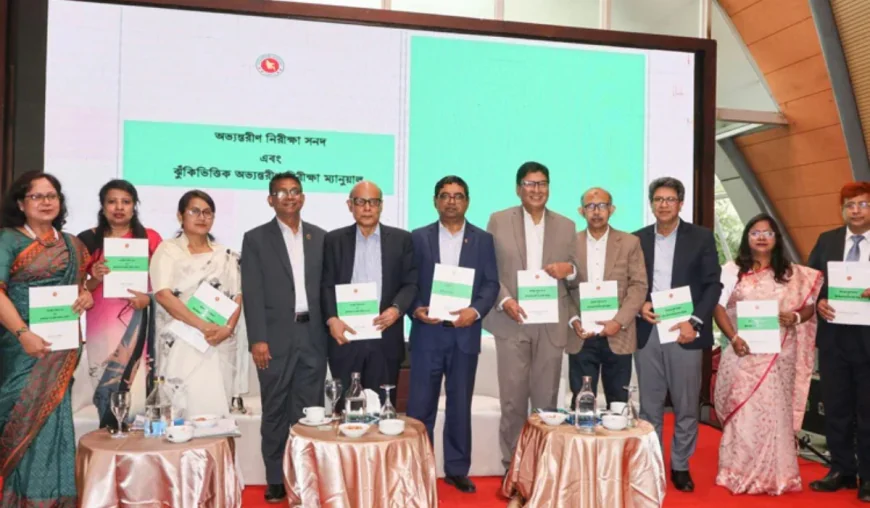
Finance Secretary Dr. Md Khairuzzaman Mozumder attended the inaugural session as the chief guest and unveiled the revised 2026 Model Risk-Based Internal Audit Charter and Manual, providing an updated framework for government internal auditing.
Dilruba Shaheena, additional secretary of Finance Division, and Dr. Ziaul Abedin, additional secretary and National Program Director of SPFMS, attended as special guests.
Md. Hasanul Matin, additional secretary of Finance Division, chaired the inaugural session. Mohammad Azad Sallal, additional secretary of Finance Division, delivered the key presentation on the Sustainability Plan for Internal Audit in the Public Sector.
Dr. Md Khairuzzaman Mozumder, in his speech said, the current government attaches great importance to institutionalize internal audit in the public sector. Introducing internal audit across ministries is a landmark step towards ensuring transparency and accountability in the management of public funds, said a press release.
"Implementing internal audit comes with challenges, but we must work together to overcome them. Our task is to turn this initiative into an effective and sustainable system that strengthens public financial management," the secretary said.
The revised 2026 Model Risk-Based Internal Audit Charter and Manual (based on Global International Audit Standard 2024) clarified auditors' mandates, responsibilities and reporting arrangements. It provided an institutional basis for examining government operations objectively and advising management on protecting public resources, strengthening controls and addressing weaknesses.
Under the framework, auditors would report functionally to the relevant internal audit committee and administratively to the secretary/principal accounting officer. This division was designed to strengthen professional independence and ensure that findings received scrutiny beyond officials responsible for daily operations.
For citizens, the significance extended to the quality of healthcare, primary education, roads and public infrastructure. Risk-based internal auditing examined financial, procurement, operational and information technology vulnerabilities that could waste resources, delay projects or interrupt services.
A sustainability roadmap proposed establishing permanent internal audit units or directorates across ministries and divisions in three phases over three years, subject to administrative approval.
Dedicated personnel, recruitment rules, professional training and adequate resources were identified as essential requirements.
The workshop included three business sessions. Sahana, Additional Secretary, Finance Division, presented the revised Risk-Based Internal Audit Charter and Manual.
Discussions also addressed digital monitoring linked to iBAS++, stronger internal controls and timely corrective action.
Business sessions and panel discussions were moderated by Finance Division Additional Secretaries Ferdous Rowshan Ara, Rahima Begum, Mohammad Abul Hashem, K M Ali Azam and Sahana, alongside Joint Secretary Syed Rashedul Hossen.
Presentations from five departments highlighted progress and barriers to institutionalizing internal audit. DGHS identified 93 risks and completed six audit reports, emphasizing waste reduction, compliance, healthcare delivery, skilled staff, funding, facilities and digital access.
PWD identified 70 risks and advanced annual audit plans, but unresolved findings, limited independence, vacancies and weak coordination required clearer responsibilities, deadlines, digital tracking and committee oversight.
LGED's transition to risk-based auditing covered 78 cost centers and produced 300 observations while temporary staffing, limited expertise and no permanent organogram constrained progress.
The DPE reported a 13-member unit, 41 risks and pilots in Raipura and Laxmipur Sadar, prioritizing personnel, training, logistics and technical support, with consolidated reporting due July 2027.
RHD identified 82 risks and completed six reports, exposing procurement, contract, land acquisition, staffing and digital weaknesses alongside additional-duty limitations.
All stressed corrective action and committee monitoring to ensure findings deliver lasting improvements in public financial management and services.
The workshop also examined an internal audit action plan for 2026-2031, focusing on permanent government structures, adequate budgets, professional capacity and coordination between internal and external auditors.
The proposed approach sought to make risk identification and corrective action a routine responsibility of public administration.





 Sponsored by