




































Dakshingram Padma Beel losing its beauty due to flower picking; Demand for long-term conservation!
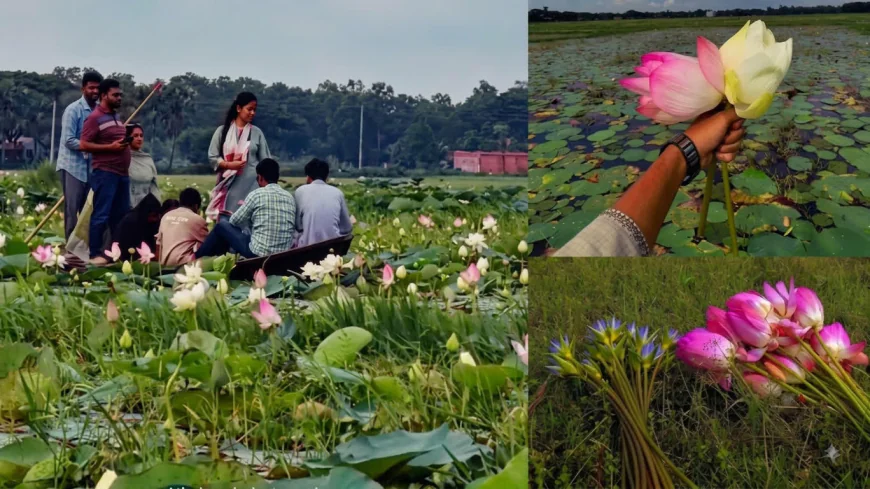
Once upon a time, the Padma Beel of Dakshingram in Burichang Upazila of Comilla was a place where people from far and wide used to visit. Whenever the monsoon came, a beautiful procession of red, white, blue and yellow lotuses would bloom across about 25 acres.
The beauty of the lotuses blooming across the vast beel under the blue sky created a heavenly atmosphere. In a short time, this Padma Beel of Dakshingram became known throughout the country and abroad through pictures spread on social media. The roots, stems, branches and flowers of the rare yellow lotus of the beel were sent to the United States along with the Department of Botany of Dhaka University for research. After that, it was also known about the initiative of UNESCO to cooperate in the overall conservation of the beel.
However, with time, that beauty has declined. Due to carelessness, lack of awareness of visitors and indiscriminate plucking of lotus flowers, this promising beel is gradually losing its beauty. Locals complain that due to the lack of regular supervision by the administration to preserve the beel, a section of visitors are plucking lotus flowers while going around in boats every day. As a result, various species of lotus, including the rare yellow lotus, are under threat.
On Wednesday, it was seen on the spot that the lotus beel is located in a vast area on the eastern side of the Dhaka-Chittagong railway line in Dakshingram of Rajapur Union of Burichang Upazila. Various colored lotuses and water lilies bloom in the monsoon water around the beel. Various species of birds including dahuk, cranes and sandpipers can be seen in the beel. Visitors come from far and wide every day to enjoy the beauty of the lotus. Currently, about 8 to 10 boats are plying around the beel. Visitors visit the beel in these boats from morning to evening.
However, a section of the visitors, along with enjoying the beauty of the beel, are also plucking lotus flowers. Some are picking the flowers while sitting on the boat. On the one hand, this is destroying the beauty of the beel, and on the other hand, there is a fear that the propagation of the lotus will be hindered.
According to local sources, the lotus of Dakshingram first came to the attention of people in the 2018 monsoon. In 2019, when local travelers captured pictures of the colorful lotuses of the beel on their mobile phones and shared them on social media, its popularity quickly spread beyond the borders of Comilla and across the country. After that, thousands of visitors started coming to see the beauty of the beel.
Due to the great interest of the visitors, the local administration also took the initiative. A lotus conservation committee was formed. Considering the diversity of lotuses and the importance of preserving them, experts also visited the beel.
In 2020, Sikder AK Shamsuddin, Executive Director of Bengal Panet Research and Development, and Professor Dr. Rakha Hari Sarkar, Chairman of the Department of Botany, Dhaka University, visited Padmabil. Later, the roots, stems, branches and flowers of the rare yellow lotus of the bill were sent to the United States along with the Department of Botany of Dhaka University for research.
Then, in 2021, it was learned about UNESCO's initiative to cooperate in the overall conservation of the bill. At that time, warning signboards were installed at various places including the entrance of the bill, red flags were hoisted in important areas of the yellow lotus, and guards were arranged. At the same time, the pressure from visitors also increased. At one stage, about a dozen part-time fishermen started making a living by taking visitors on boats to the bill.
However, the situation changed after 2023. Since the assurance of conservation and acquisition was not effective, the landowners of the bill are continuing various activities as before, including cultivation, fishing, clearing the kachuripana and cutting grass in the dry season. At one stage, the signboards, red flags and instructions placed at various places on the beel were no longer visible. As a result, the lotus pond became largely without guardians.
The entire beel, which is about 25 acres in area, is privately owned. The landowners cultivate fish along with rice during the monsoon season. When the monsoon rains begin after winter, lotus flowers start blooming on the beel. As the amount of water increases during the monsoon, red, white, blue and yellow lotuses spread across the beel.