



















‘Ekshathe Choli, Ekshathe Bachi’ Breaks Barriers, Promotes Inclusion in Theatre
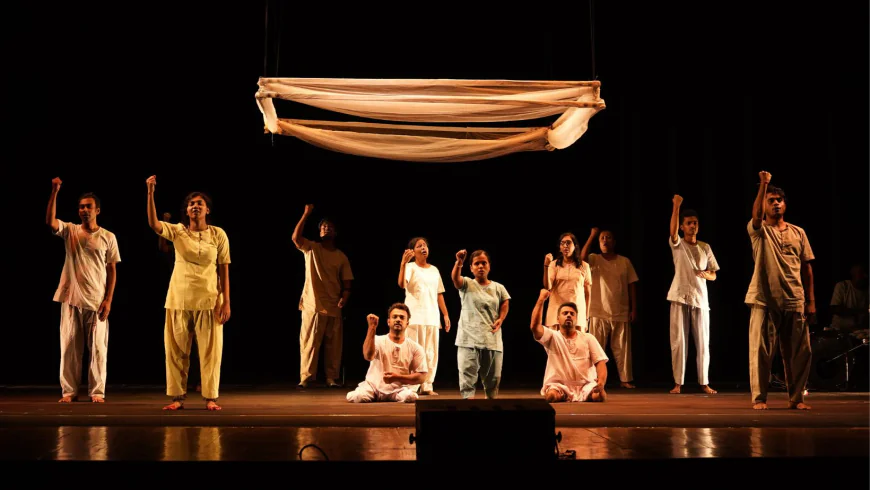
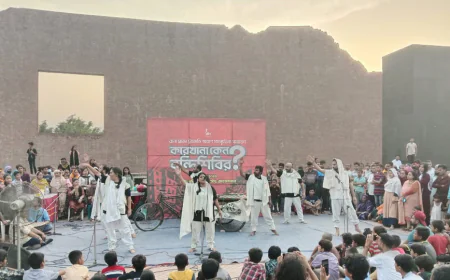
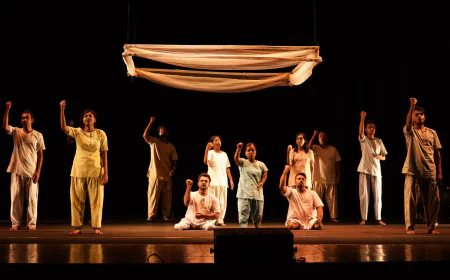
On a dimly lit stage, actors appear, their bodies entangled together as they move towards something. They run, chained by circumstances; some in wheelchairs, some able-bodied, some visually impaired – yet all are moving towards the same destination. Another actor comes forward. Visually impaired, she begins to recite verses from “Nirjhorer Shopnobhongo” by Rabindranath Tagore. A poem that sings the song of freedom, about breaking the shackles of isolation and liberation. That is how the play, “Ekshathe Choli, Ekshathe Bachi” begins.
The play, directed by Nasir Uddin Yousuff, was staged on the final day of Dhaka Theatre and Bangladesh Graam Theatre’s programme celebrating the renowned playwright Selim Al Deen’s 77th birth anniversary at the National Theatre Hall of Bangladesh Shilpakala Academy. Written by H S Rajon and Rafiqul Islam, who was also the co-director, the play was staged by Sundaram, a theatre troupe made up entirely of actors with disabilities.
“Ekshathe Choli, Ekshathe Bachi” revolves around the lived realities of people with disabilities. The play shows a theatre director impatiently checking through his tab, looking at the online applications sent to him for the position of an actor for his production. So far, however, there have been only two chosen applicants. As he ponders what he is going to do, a group of people barges in, demanding that they, too, want to be a part of his play. These people, all holding application forms in their hands, are people with disabilities. Some use wheelchairs, some are visually impaired, some have speech and hearing impairments; all of them are interested in acting. The director is perplexed, questioning how theatre, a visual medium that needs body language to convey meaning, can have people with disabilities as actors. He acknowledges that theatre, as it currently exists, is not accessible to people with disabilities, yet he shows little enthusiasm about changing it. However, the applicants protest, advocating for their right to participate in and engage with the art form. Eventually, the director relents, giving them the chance to showcase their skillset.
The applicants face the challenge head-on – showcasing their skills through singing, acting, miming, and many more. Whatever limitations their disabilities impose upon them, they use other means to express their art. These limitations transform into different forms of expression.
The play blends contemporary realities with Rabindranath Tagore’s “Dakghar” (The Post Office), with the actors staging a play within the play, echoing the plight of the protagonist, Amal. It is a call for liberation, acceptance, dignity and belonging that transcends centuries and realities.
Before the play began, the director Nasir Uddin Yousuff shared a few words. He spoke of the playwright’s birth anniversary being celebrated in more than a hundred locations across Bangladesh through theatre, art, dance, music and recitals – something that, he said, brings joy and affirms that joy can be found even amidst sorrow.
“Selim Al Deen’s passing was a sudden shock and tragedy for our Dhaka Theatre and for the cultural and self-assertion movements of Bangladesh. In the face of that tragedy, we try our absolute best to find a bit of joy by engaging with him and his plays,” he said.
When speaking about the play, he said that it was about people with disabilities. “We have formed a group with people with disabilities, named Sundaram. Sundaram was created by Dhaka Theatre, just as Bangladesh Graam Theatre was also established by Dhaka Theatre. We realized that although Sundaram has been working for over 12 years and has performed here before, the troupe has never appeared before you through a festival in this manner.”
“We call this ‘inclusive theatre’, and when we speak of inclusive theatre, we must keep in mind, remember, and believe that our society also needs to become inclusive,” the director added.
The play “Ekshathe Choli, Ekshathe Bachi” is a play that features nine actors with disabilities and three non-disabled actors. The former are from Sundaram and the latter are from Dhaka Theatre. This one-hour-long short production is a theatrical journey depicting the lived realities of people with disabilities. It confronts the deeply entrenched prejudices and beliefs that are embedded in society – beliefs that create barriers and result in one group of people facing discrimination from the other. Within structures shaped by such invisible barriers and a lack of understanding, the place for people with disabilities in society is often predetermined.
In the play, the actors with disabilities tell the director how the online application form did not give the option to disclose disability, or how notable buildings like National Theatre Hall itself did not have any elevators, thus making them inaccessible to people with disabilities.
The director, Nasir Uddin Yousuff, went on to say that despite the large number of people with disabilities in Bangladesh, they are not visible on the streets because many remain confined to their homes. When speaking of actors with disabilities, he mentioned that there are theatre troupes for them in Europe and he’d like Bangladesh to have more groups like Sundaram.
He said that they have created eight groups in eight divisions and shows can be staged with them as well, but it requires a lot of support.
“Just as we said in the play, there should be no divide between disabled and non-disabled performers, that is what we want. Whatever limitations there may be can be compensated for if the government, alongside others, steps forward,” he said. He also highlighted how women with disabilities face severe marginalisation and discrimination, and how often mothers are blamed for their children’s disabilities.
“My plan is to expand this—we are already active in eight divisions, and next, we will work in 64 districts, but we need government support.”
The director also elaborated on the accommodations made to assist the actors with disabilities. The use of sound was deliberate to help the actors with visual impairment to navigate the stage, while ropes were taped on the stage to assist their navigation. An actor who was a sign language interpreter was also amongst the cast to assist the actors with speech or hearing impairments.
“We believe we must escape the black-and-white dogmas regarding rich and poor, different religions, and sectarianism, and build an inclusive society, country, and state. Just as we have managed to perform an inclusive play on stage today: Together We Stand, which in Bengali is ‘Ekshathe Choli, Ekshathe Bachi’,” added Yousuff.
When speaking with some of the cast members, Md Delowar Hossain Sujon and Nur Mohammad, both with physical disabilities, said that the lack of funds prevents them from practising regularly.
“If the Ministry of Cultural Affairs pays a little attention to us and officially patronizes us, and if it supports Sundaram, we hope to not only perform in Bangladesh but also, perform plays on stage abroad and represent Bangladesh on the international stage as theatre artistes”, they said.
“Nasir Uddin Yousuff Bachchu Sir formed Sundaram specifically for us, and so far, it is the only one of its kind in Bangladesh. If it receives some support—whether financial, funding, or government grants—then I believe we can progress much further and represent ourselves on the global stage”, said Sujon.
Ruma Khan Kajal partially lost her eyesight due to an accident, and she has been working with Sundaram since 2019. Initially feeling shy about participating in theatre, she shared that she gradually got out of her shell.
“My teachers, trainers, and every crew member at Sundaram have contributed to shaping me into who I am today. I hope they will continue to prepare me to move further forward in the future. I want to uphold the honor and dignity of Sundaram because I want our disabled theatre to go a long way one day. For that, we actually need support,” she said, “I am drawing the attention of the government. Recitation, singing, and dancing are rights for all disabled people, and theatre and entertainment are also their rights, which is recognized under our Rights and Protection of Persons with Disabilities Act, 2013”.
Calling theatre a mirror of society, she also emphasised the need for a theatre institute for people with disabilities where artistes can get professional training.
The cast includes Mustafa Ratan, Md Shahzada Somrat, Nur Mohammad, Md. Delower Hossain Sujon, Rumana Akter, Lovely Khatun, Mahiya Nakib, Rakib Islam, Mamunur Rashid Efti, Rabbi Mia, Ruma Khan Kajal, Ahsan Habib.
The word “Sundaram” derives from Sanskrit, meaning “You are beautiful”. True to its name, the troupe, like the play itself, is a step towards a society where everyone can be appreciated and recognised. Through mutual understanding, shared effort and accommodation for the people who need it, inclusion can become not an exception but an inherent act of acceptance.
The event closed with Nasrin Nahar, Coordinator of the programme.