

























‘Tobuo Jege Uthi’ explores violence and the objectification of women under patriarchy
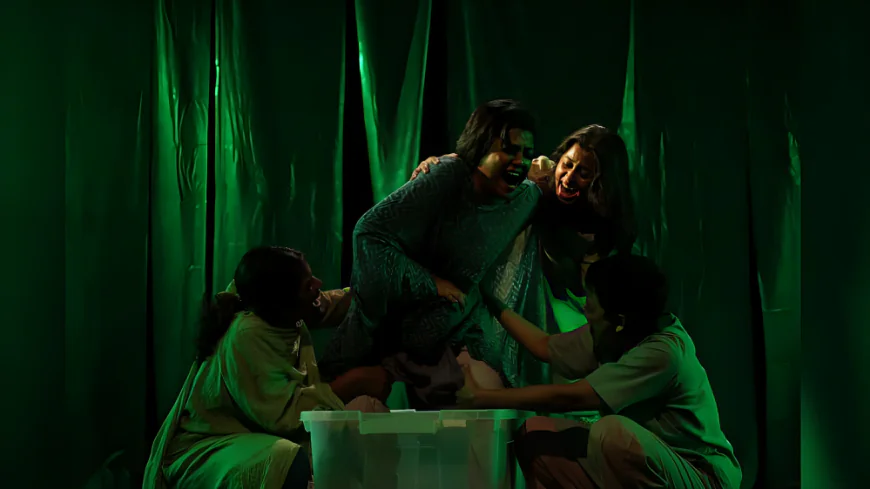
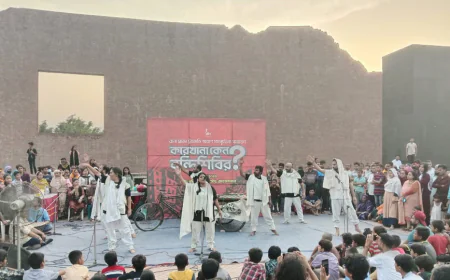
In a dimly lit room, bodies of women and men lie on the ground, arms tucked to their chests, knees folded, bodies curled into a foetal position and a rope, an umbilical cord, as though they are still in their mothers’ womb. They rise, awoken from their slumber. These children of humanity roam the stage aimlessly, playfully. They giggle and skip, hand in hand as they circle the stage, unaware of their differences, for there are none.
Until the forces separate them. The beat of the drums parts them into rows of women and men, divided by gender. One holding more power over the other. A gnawing chasm present between the two.
The women try to bridge the gap, taking a step forward, their hands gently holding the men, standing beside them, they are pushed away, thrown to the back, rejected by their peers. They still move forward, despite the rejection, bridging the gap again, only to be rejected, viciously. They are humiliated and scarred, again and again and again. Yet they still persist. That is how women have always persisted throughout history. Despite the commodification, despite the damnation.
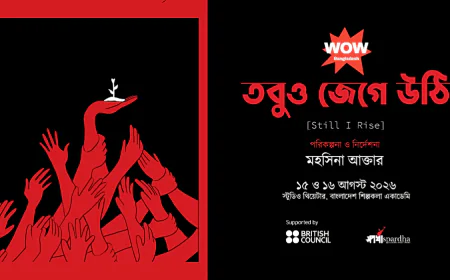
Directed by Mohsina Akter, Spardha: Independent Theatre Collective’s production of “Tobuo Jege Uthi” depicts the experience of womanhood and the struggle of women in the maw of patriarchy. It explores identity and power, how society shapes them.
The play was staged at the Studio Theatre Hall of Bangladesh Shilpakala Academy in Dhaka on August 15 and 16, before Spardha ITC takes the production to Chattogram, Sylhet and Rajshahi. The initiative is supported by the British Council’s Women of the World (WOW) 2026.
“Tobuo Jege Uthi” has little dialogue and structure; there is no introduction, no conventional curtain rise or curtain call. There is very little dialogue here, but each scene is brought to life through the actors’ stellar acting and their body language. This play has no protagonist, and when the fourth wall breaks, it almost feels like the audience too is a part of the play. Despite being almost wordless, this play is not silent by any means. The actors are phenomenal, the music and sound design are immaculate, elevating the experience. The play is only 48 minutes long, and despite the visceral reaction it evokes, it keeps the audience asking for more.
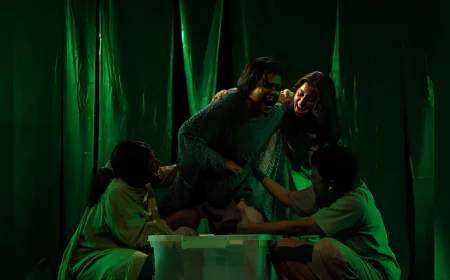
Akter’s “Tobuo Jege Uthi” is a scalding commentary on patriarchy and the commodification of women, and it does not shy away from depicting the horrors of it. It shows how a society shapes women and men alike, how both are forced into prescribed moulds, how those who reject the conditioning are ridiculed. In a particularly disturbing sequence, a woman is manhandled as she is told to act in a certain way. Most women do end up doing so – dress in a certain way, smile pleasantly, move in a certain way, be accommodating and non-confrontational. Just like a doll, a product to be consumed. Her selfhood was ignored or actively discouraged. Here lies the tragedy: the women who reject it, who opt to exercise their agency, are ridiculed not only by men, but also by fellow women. For it is easier to be the “good” woman, adhering to the internalised misogyny that keeps the system intact.
In another sequence, the play shows how masculinity is manufactured. It shows how men are encouraged to perform masculinity through machismo and violence. They urinate in the streets, cheering each other on in their display of masculine bravado. It shows how they will overburden themselves, physically taking on more than they can carry because that is what it is to be a man. The play does not hold back from showing how these boys turned men are perturbed when their female peers close the distance, the role of “provider” getting challenged; nor does it hold back from showing how these men end up inflicting brute force and sexual violence upon women, to subdue them.
The play is almost disturbing in its portrayal, too visceral, too real. One will almost feel like looking away, but they will be compelled to watch it till the end. In the play, women are subjected to fingers pointed at them, voices condemning them through slut-shaming, dissecting their bodies under the male gaze. The few phrases uttered throughout the play do not sugar-coat the bigotry and misogyny that are perpetuated in society. Words like shundor, rate koto?, 36-24-36, apu ki chele naki meye?, nice figure, wonderful repeat like a sinister chant from behind the opaque curtains as the lecherous gaze of patriarchy haunts both the women on stage and the audience alike.
The sound and music design complement, and at times control, the atmosphere of the play, creating an unsettling tension with remarkable precision. It dictates the movement, pulling the audience into the world the actors inhabit.
The play forces the audience to witness what a violent experience it is to be a woman – from facing discrimination based on gender to the physical and psychological horror that is imposed on and the ones that come with residing with, inhabiting, the female body. Starting from birth, then puberty and finally childbirth, showing pregnant women going through excruciating pain to give birth to another being into the world – all while words like ma and whore are chanted in the background. The juxtaposition is jarring, but it makes sense, because in the eyes of patriarchy, the mother and the whore are one and the same. The body which gives birth to civilisation is oppressed, consumed, commodified and exploited; the identity and the agency of the woman who inhabits it is always questioned and diminished.
In this regard, “Tobuo Jege Uthi” is a difficult watch, particularly for women due to how it may get under the skin. It is raw and visceral in its portrayal of patriarchal violence and oppression, mirroring the traumatic experiences of control and threat to bodily autonomy that all women and gender-diverse individuals across generations have faced. It may fill the audience with righteous fury.
But the near-wordless nature of the play is not accidental. Director Mohsina Akter emphasises the importance of theatre as a visual medium and the language of the body. The play was first staged in 2024, in the aftermath of the July uprising in Bangladesh. When talking about the inspiration for the play, Akter said, “During the uprising, everyone seemed united regardless of race, religion, or caste, and women were at the forefront - holding onto trucks, marching with the bodies of the deceased, and shielding friends from the police. However, as soon as the movement ended, a societal push began to send women “back to their homes”. While the dream of equality was shared during the uprising, the rights of women and people with marginalised gender identities once again came under question in the post-uprising period.
She reflects on her own personal experience of feeling immense pressure to constantly prove her worth as a woman and a theatre worker, even after achieving professional success abroad. Such many unvoiced thoughts were expressed through the play. Her reflections extend beyond women, as she also considers how society oppresses boys by stripping them of their emotions, describing it as a “lobotomy” of feelings where they are taught they cannot cry or show vulnerability, and are only encouraged to perform masculinity through aggression. This lack of emotional health breeds toxicity, which ultimately results in violence against women.
When talking about the financial aspect of the production, Akter also mentioned that there is a lack of funding in the theatre scene, preventing the sector from flourishing. The title “Tobuo Jege Uthi” draws inspiration from American poet Maya Angelou’s poem “Still I Rise”. Just like the poem, Mohsina Akter’s play isn’t just about disillusionment and frustration, it is also about moving forward despite the violence and humiliation. It is about persistence and resistance despite everything, again and again.