








































Saving Whales Could Help Heal the Oceans
Marine biologists say protecting whale populations may restore biodiversity, strengthen food chains, and support the planet’s natural climate balance.
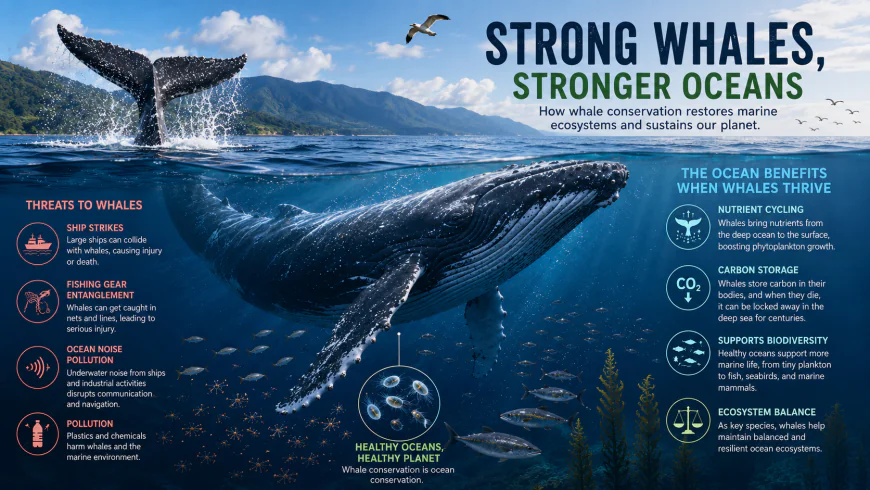

Whales are often celebrated as the giants of the ocean, admired for their immense size, intelligence, and spectacular migrations. Yet beyond their cultural significance and ecological intrigue, scientists increasingly recognize that whales are among the most influential engineers of marine ecosystems. Their presence shapes ocean food webs, supports biodiversity, and even contributes to the planet's natural carbon cycle.
As nations race to protect marine biodiversity and address climate change, marine biologists argue that conserving whale populations is about far more than saving a single group of species. It is about restoring the health and resilience of entire ocean ecosystems.
Nature's Ecosystem Engineers
Whales play a unique role in maintaining the balance of marine environments. Unlike many other large animals, they transport nutrients vertically and horizontally throughout the ocean.
When whales dive deep to feed and return to the surface to breathe, they release nutrient-rich waste containing nitrogen, iron, and phosphorus. These nutrients fertilize surface waters, stimulating the growth of phytoplankton, microscopic marine plants that form the foundation of ocean food chains.
Healthy phytoplankton populations support fish, seabirds, marine mammals, and countless other organisms. They also produce a significant share of the Earth's oxygen while absorbing large amounts of carbon dioxide from the atmosphere.
This natural nutrient recycling process, often referred to by marine scientists as the "whale pump," demonstrates that whales are active contributors to ocean productivity rather than passive inhabitants.
Whales and Climate Regulation
Marine biologists have increasingly highlighted the connection between whale conservation and climate regulation.
Large whales accumulate substantial amounts of carbon in their bodies throughout their lifetimes. When they die naturally and sink to the ocean floor, a process known as a "whale fall", that carbon can remain stored in deep-sea sediments for decades or even centuries.
Whale falls also create unique ecosystems. Their carcasses provide food and habitat for hundreds of species, including deep-sea fish, crabs, worms, and specialized bacteria. These ecosystems can survive for years, supporting biodiversity in some of the ocean's most remote environments.
Together, nutrient cycling and long-term carbon storage illustrate how whales contribute to both marine biodiversity and the global carbon cycle.
Signs of Recovery
Commercial whaling drove many whale species to the brink of extinction during the twentieth century. International conservation efforts, including hunting restrictions and marine protection measures, have allowed several populations to recover.
Marine biologists have documented encouraging increases in humpback whale populations in many regions, while some other species are gradually showing signs of recovery.
However, scientists caution that recovery remains uneven. Several whale species continue to face significant threats, and some populations remain critically endangered.
New Threats in a Changing Ocean
Today's greatest challenges differ from those of the past.
Climate change is altering ocean temperatures and shifting the distribution of krill and small fish that whales depend upon for food. As prey moves into new areas, whales must adapt by changing migration routes and feeding grounds.
Increasing global shipping traffic also raises the risk of vessel collisions. Ship strikes have become a major source of mortality for several whale species, particularly in busy commercial shipping corridors.
Fishing gear presents another serious danger. Entanglement in ropes, nets, and traps can leave whales severely injured, reduce their ability to feed, or ultimately lead to death.
Marine pollution, including plastics, chemical contaminants, and underwater noise, adds further stress to whale populations. Persistent noise from commercial ships and industrial activities can interfere with communication, navigation, and reproduction.
Why Marine Biologists Matter
Understanding these complex challenges requires long-term scientific research.
Marine biologists now employ advanced technologies that were unimaginable only a few decades ago. Satellite tracking devices reveal migration routes across entire oceans. Drones collect images that help assess body condition without disturbing the animals. Underwater acoustic sensors record whale vocalizations, allowing researchers to monitor populations over vast distances.
Genetic analysis has also transformed conservation science, helping researchers identify distinct populations and measure genetic diversity, an essential factor for long-term survival.
These tools provide policymakers with the scientific evidence needed to design effective marine protected areas, regulate shipping routes, and improve fisheries management.
A Shared Responsibility
Protecting whales cannot be achieved by conservation organizations alone.
Governments, shipping companies, fishing industries, researchers, and coastal communities all play important roles. Slower vessel speeds in high-risk areas, improved fishing gear designed to reduce entanglements, expanded marine protected areas, and continued investment in scientific research are among the measures that can reduce pressure on whale populations.
International cooperation is equally important because whales migrate across national boundaries, making conservation a truly global challenge.
Looking Ahead
The recovery of whales represents one of the world's notable conservation achievements, but it is also a reminder that healthy oceans depend on healthy wildlife.
Marine biologists increasingly view whales as indicators of ocean health. Where whales thrive, marine ecosystems are often more productive, more diverse, and more resilient.
Conserving whales is therefore not only an effort to protect some of the ocean's most magnificent creatures. It is an investment in stronger marine ecosystems, healthier fisheries, greater biodiversity, and a more stable climate.
In an era of accelerating environmental change, safeguarding whales may prove to be one of the most effective ways to help restore the oceans that sustain life on Earth.





 Sponsored by